
Phronima
Latreille, 1802
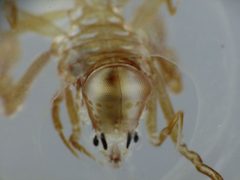
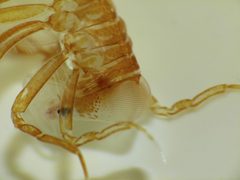
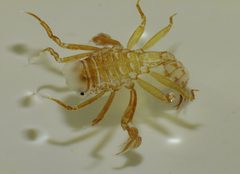
Phronima is a of small, deep-sea hyperiid amphipods found throughout the world's oceans except polar regions. These semitransparent pelagic crustaceans are technically rather than : females attack salps, hollow out their gelatinous tunicates to create protective 'barrels,' and rear their young inside these structures. The genus possesses extraordinary adapted to detect blue-green wavelengths, enabling navigation in dim mid-ocean environments where serves as critical ecological signals. Phronima has gained cultural recognition as a possible inspiration for the design in the 1986 film 'Aliens.'
Pronunciation
How to pronounce Phronima: /froʊˈnaɪmə/
These audio files are automatically generated. While they are not always 100% accurate, they are a good starting point.
Images
Habitat
Pelagic zone of the deep ocean; inhabits midwater environments throughout tropical and temperate marine waters. Females construct and occupy protective barrels derived from hollowed salp tunicates, which provide shelter, buoyancy, and chambers.
Distribution
Circumglobal in tropical and temperate oceans; absent from polar regions. Documented from Mediterranean waters and studied in aquaculture contexts in South Sulawesi, Indonesia.
Diet
Females feed on salp tissues using mouths and claws to consume the animal and excavate its gelatinous shell. Presumed to capture additional zooplankton prey using enlarged gnathopods.
Host Associations
- salps (tunicates) - females attack and consume salps, then inhabit hollowed tunic remains as protective barrels for rearing young
Life Cycle
and developing young are carried within the maternal barrel. Multiple growth stages of young have been documented cohabiting with mothers; in Phronima sedentaria and P. dunbari, young of single growth stages occupy barrels together, though P. dunbari has shown mixed-stage cohabitation in at least one observation. Late-stage young eventually leave the barrel and may cling directly to the mother.
Behavior
Females exhibit specialized barrel-construction : attacking salps, consuming their tissues, and converting the remaining tunic into a mobile shelter that is carried through the water. This barrel is periodically replaced when damaged. Reduced swimming activity compared to other hyperiids, with modified pleopods and reduced uropods. (anhydrobiosis) has been applied to zoea larvae in aquaculture contexts to enable storage and transport.
Ecological Role
on salps and zooplankton in pelagic . Unique barrel-dwelling creates microhabitat structures in the open ocean. Serves as potential live food source in aquaculture, with documented success in improving survival and growth of black tiger shrimp (Penaeus monodon).
Human Relevance
Investigated as alternative live feed for aquaculture, with studies demonstrating potential to substitute Artemia salina in shrimp . Cultural significance as possible inspiration for the in James Cameron's 1986 film 'Aliens,' based on morphological similarities including the broad crest, tubular upward-pointing , and 'necro-parasitic' reproductive strategy.
Similar Taxa
- Phronimella elongatacongeneric barrel-dwelling hyperiid with similar maternal care ; distinguished by elongated body form and consistent single-growth-stage cohabitation of young
- other Hyperiideamost hyperiids lack barrel-construction and maternal shelter provision; Phronima distinguished by reduced swimming appendages and obligate association with salp-derived structures
Misconceptions
Commonly mislabeled as ; more accurately termed because females kill and consume the (salp) rather than feeding continuously on a living host. The barrel is a constructed shelter from host remains, not a living host association.
Sources and further reading
- BugGuide
- Wikipedia
- GBIF taxonomy match
- iNaturalist taxon
- NCBI Taxonomy
- Catalogue of Life
- Passalidae | Beetles In The Bush
- Dynamics of Endemic Habitats Microcrustacean Phronima Suppa (Phronima sp) as Determinants of Artificial Production Development
- Survival Rate and Quality of Phronima Suppa (Phronima sp) Zoea with the Cryptobiosis Application
- OBSERVATIONS ON THE ANATOMY AND BEHAVIOR OF PHRONIMA SEDENTARIA (FORSKAL) (AMPHIPODA: HYPERIIDEA)
- Penngaruh Pemberian Pakan Alami yang Berbeda dari Jenis Zooplankton (Artemia salina, Brachionus rotundiformis dan Oithona similis) terhadap Performa Pertumbuhan Phronima sp.
- Observations on the Anatomy and Behavior of Phronima sedentaria (Forskal) (Amphipoda: Hyperiidea)
- Fine structure of the compound eyes of the midwater amphipod Phronima in relation to behavior and habitat
- Mother–young cohabitation in Phronimella elongata and Phronima spp. (Amphipoda, Hyperiidea, Phronimidae)
- A new computational model illuminates the extraordinary eyes of Phronima.