
Stenopus
boxer shrimp, coral shrimp, banded coral shrimp
Species Guides
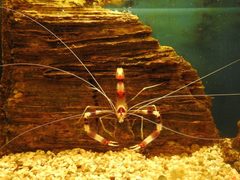
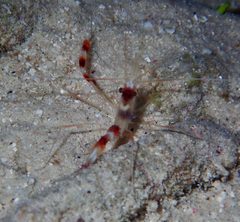
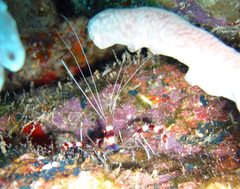
1- Stenopus hispidus(banded coral shrimp)
Stenopus is a of marine decapod crustaceans comprising eleven described , commonly known as boxer or coral shrimps. Members are characterized by enlarged, asymmetrical chelipeds used in defense and intraspecific combat. Several species, particularly Stenopus hispidus, are significant in the ornamental aquarium trade and function as cleaner organisms in reef . The genus exhibits monogamous social structures and prominent agonistic mediated by dopamine and neuroendocrine .
Pronunciation
How to pronounce Stenopus: //ˈstɛn.oʊ.pəs//
These audio files are automatically generated. While they are not always 100% accurate, they are a good starting point.
Images
Habitat
Marine subtidal environments, primarily coral reefs and rocky substrates. Depth range extends from shallow waters to mesophotic zones; Stenopus devaneyi has been documented at 60 meters depth at Mayotte Island. occupy crevices and caves within reef structures.
Distribution
Indo-West-Pacific region, with extensions into the Atlantic. Stenopus hispidus and Stenopus spinosus confirmed in Brazilian waters at 27°S. Stenopus devaneyi reported from Mayotte Island in the Western Indian Ocean.
Behavior
Exhibits prominent agonistic when encountering conspecifics of the same sex, involving tactile contact via and antennules. Agonistic interactions are mediated by dopamine, , octopamine, and glutamate, with dopamine and acetylcholine playing primary roles—a distinct pattern from the serotonin-based aggression regulation observed in most other pan-crustaceans. Monogamous social structure. Stenopus hispidus establishes cleaning stations visited by reef fishes and hawksbill turtles (Eretmochelys imbricata).
Ecological Role
Cleaner in coral reef ; removes and debris from client fishes and marine turtles. Serves as for parasitic isopods including Argeiopsis inhacae, which causes in females.
Human Relevance
Highly valued in the ornamental aquarium trade, particularly Stenopus hispidus. Collection from wild threatens reef and has prompted development of captive breeding protocols. Serves as a non-insect model organism for studying neuroendocrine regulation of agonistic in arthropods.
Sources and further reading
- BugGuide
- Wikipedia
- iNaturalist taxon
- NCBI Taxonomy
- Catalogue of Life
- Mating Behavior and Spawning of the Banded Coral Shrimp Stenopus hispidus in the Laboratory
- MATING BEHAVIOR AND SPAWNING OF THE BANDED CORAL SHRIMP STENOPUS HISPIDUS IN THE LABORATORY
- A new report of the stenopodid shrimp Stenopus devaneyi Goy, 1984 from the Western Indian Ocean
- Neuromodulatory roles of dopamine and acetylcholine in mediating agonistic behaviors of boxer shrimps (Stenopus species)
- Hawksbill turtles visit moustached barbers: cleaning symbiosis between eretmochelys imbricata and the shrimp stenopus hispidus
- Effects of Body Size on Growth, Survivorship, and Reproduction in the Banded Coral Shrimp, Stenopus Hispidus
- Agonistic behaviors of boxer shrimps (Stenopus Species): Insights into the importance of antennae, antennules and tactile contact
- Preliminary observations on the reproductive biology of ornamental cleaner prawns Stenopus hispidus Lysmata amboinensis Lysmata debelius
- Extending the southern range of four shrimps (Crustacea: Decapoda: Stenopodidae, Hippolytidae and Alpheidae) in southwestern Atlantic (27<sup>o </sup>S) and confirming the presence of Mediterranean Stenopus spinosus Risso, 1827 in Brazil
- Mating behaviour and embryonic development of the marine ornamental shrimp, Stenopus hispidus Olivier, 1811 in captivity
- Parasitic castration of the stenopodid shrimp Stenopus hispidus (Decapoda: Stenopodidae) induced by the bopyrid isopod Argeiopsis inhacae (Isopoda: Bopyridae)