
Stenopodidae
Claus, 1872
Coral Shrimps, Boxer Shrimp
Genus Guides
1- Stenopus(boxer shrimp)
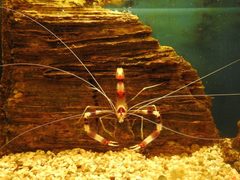
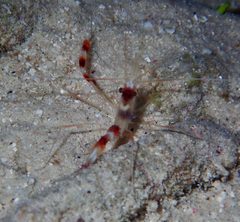
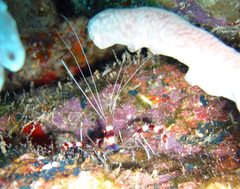
Stenopodidae is a of marine decapod crustaceans comprising approximately 6 and more than 30 described extant . The family has a fossil record extending to the Devonian period. Members are commonly known as coral shrimps or boxer shrimp and are distinguished from true shrimp and prawns by morphological and phylogenetic affinities closer to reptant decapods such as lobsters and crabs. The family exhibits diverse ecological associations including fish cleaning , commensalism with deep-water corals, and obligate associations with hexactinellid sponges.
Pronunciation
How to pronounce Stenopodidae: //ˌstɛnoʊˈpɒdɪdiː//
These audio files are automatically generated. While they are not always 100% accurate, they are a good starting point.
Identification
Stenopodidae may be recognized by the greatly enlarged third pereiopod ( leg), a diagnostic feature distinguishing them from caridean shrimp and dendrobranchiate prawns where leg enlargement is absent or follows different patterns. In reptant decapods such as lobsters and crabs, the first pereiopod is enlarged rather than the third. This morphological trait provides a field diagnostic for distinguishing stenopodids from superficially similar natantian decapods.
Images
Habitat
Marine environments ranging from shallow subtidal rocky reefs to deep-sea . Documented associations include rocky islands at 3–25 meters depth, deep-water coral habitats, and hexactinellid sponge beds. Some occupy cryptic habitats in subtidal zones.
Distribution
Atlantic Ocean including Caribbean Sea, Gulf of Mexico, southwestern Atlantic to 27°S (Brazil), eastern Atlantic off Morocco and Western Sahara, and western Atlantic off Georgia (USA). Indo-Pacific distribution also occurs. Fossil record extends to Devonian.
Host Associations
- Hexactinellid sponges - Obligate associateSpongiocaris hexactinellicola described from association with glass sponges at Tartar Bank, Bahamas
- Deep-water coral Lophelia pertusa - CommensalOdontozona documented as commensal on this deep-sea hard coral in Gulf of Mexico and Atlantic
- Fish clients - Cleaning Stenopodidae participate in fish cleaning stations; specific body regions cleaned vary by diel activity pattern of cleaner
Behavior
Cleaning has been documented in members, with cleaners showing preference for cleaning mouth and gill cavities of fish clients, while cleaners prefer external body surfaces. Fish clients adopt distinct poses day and night, suggesting tactile recognition of cleaner activity periods. Mating behavior in Stenopus hispidus includes typical .
Ecological Role
Fish cleaning/cleaner shrimp ; removal of and necrotic tissue from fish clients. Commensal and mutualistic associations with benthic including corals and sponges. by bopyrid isopods (documented in Stenopus hispidus) indicates complex - dynamics within .
Human Relevance
Subject of SCUBA-based ecological research. Some serve as indicators for marine biodiversity monitoring programs. Taxonomic features documented in color imagery to support in situ identification for future monitoring.
Similar Taxa
- PalaemonidaeBoth include fish-cleaning shrimp; distinguished by stenopodid third pereiopod enlargement versus palaemonid
- HippolytidaeBoth include fish-cleaning shrimp; distinguished by stenopodid third pereiopod enlargement and phylogenetic placement closer to reptant decapods
- CarideaSuperficially similar natantian decapods; stenopodids distinguished by third pereiopod enlargement and closer affinity to lobsters and crabs rather than true shrimp
Misconceptions
Often confused with shrimp or prawns; however, Stenopodidae are not true shrimp but belong to a distinct lineage (Stenopodidea) with closer phylogenetic affinities to reptant decapods such as lobsters and crabs.
More Details
Fossil Record
Oldest record dates to the Devonian period. Extinct include Devonostenopus and Phoenice.
Parasitism
Stenopus hispidus subject to by bopyrid isopod Argeiopsis inhacae; occurs in branchial chamber with female-biased and complete reproductive suppression despite normal mating .
Taxonomic Note
Stenopodidae represents the sole extant family within infraorder Stenopodidea. Approximately 71 extant recognized across 12 in broader Stenopodidea, though family-level generic composition varies by source (6 genera per some accounts).
Sources and further reading
- BugGuide
- Wikipedia
- GBIF taxonomy match
- iNaturalist taxon
- NCBI Taxonomy
- Catalogue of Life
- ASPECTOS ETOLOGICOS Y ECOLOGICOS DE CAMARONES LIMPIADORES DE PECES (Natantia: Palaemonidae, Hippolytidae, Stenopodidae).
- SPONGIOCARISHEXACTINELLICOLA, A NEW SPECIES OF STENOPODIDEAN SHRIMP (DECAPODA: STENOPODIDAE) ASSOCIATED WITH HEXACTINELLID SPONGES FROM TARTAR BANK, BAHAMAS
- Spongiocaris hexactinellicola, a New Species of Stenopodidean Shrimp (Decapoda: Stenopodidae) Associated with Hexactinellid Sponges from Tartar Bank, Bahamas
- Parasitic castration of the stenopodid shrimp Stenopus hispidus (Decapoda: Stenopodidae) induced by the bopyrid isopod Argeiopsis inhacae (Isopoda: Bopyridae)
- Redescription of Odontozona edwardsi (Bouvier, 1908) (Decapoda: Stenopodidea: Stenopodidae) and description of a new species of Odontozona commensal on the deep-water coral, Lophelia pertusa (Linneaus, 1758)
- Extending the southern range of four shrimps (Crustacea: Decapoda: Stenopodidae, Hippolytidae and Alpheidae) in southwestern Atlantic (27<sup>o </sup>S) and confirming the presence of Mediterranean Stenopus spinosus Risso, 1827 in Brazil