
Stenopus hispidus
(Olivier, 1811)
banded coral shrimp, banded cleaner shrimp, coral banded shrimp
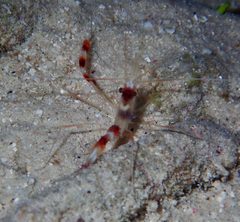
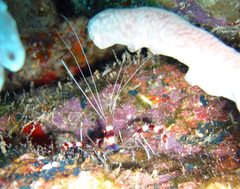
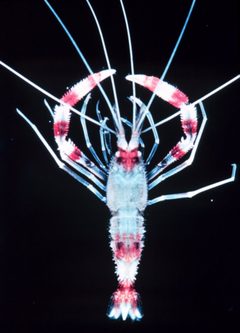
Stenopus hispidus is a marine decapod crustacean in the Stenopodidae, recognized as one of the most widely distributed cleaner shrimps in tropical seas. The reaches 60 mm in total length and exhibits striking red-and-white banded coloration on the , , and enlarged third pereiopods. It is exclusively monogamous, with pairs occupying reef territories 1–2 meters in diameter. The species advertises cleaning services to client fish through a distinctive "dancing" involving lateral movement, and removes , fungi, and damaged tissue using its three pairs of claws. Females are typically larger than males and carry externally fertilized until hatching.
Pronunciation
How to pronounce Stenopus hispidus: //ˈstɛnəpəs ˈhɪspɪdəs//
These audio files are automatically generated. While they are not always 100% accurate, they are a good starting point.
Identification
Distinguished from other cleaner shrimps by the combination of red-and-white banded pattern, extremely long white , and spiny body surface. The Lysmata (cleaner shrimps) lacks the pronounced spination and banded claw coloration. The dancing —waving long antennae laterally while remaining near a fixed station—is diagnostic for the ' cleaning advertisement. The monogamous pair bonding and territorial defense of 1–2 meter reef areas are behavioral identifiers. Spiny body texture separates it from smooth-bodied decapods in similar .
Images
Appearance
Transparent ground color with vivid red and white transverse bands on , , and enlarged third pereiopods. and remaining pereiopods white. Body covered in prominent spines on carapace, abdomen, and third pereiopods. Two pairs of extremely long, biramous antennules and antennae. Total length up to 60 mm. Females typically larger than males.
Habitat
Coral reef below the intertidal zone, from shallow reef flats to depths of 210 meters. Occupies fixed stations on reef substrate, typically in crevices or under ledges. Requires hard substrate for territory establishment and .
Distribution
Pan-tropical distribution extending into temperate areas. Western Atlantic Ocean from Canada to Brazil, including Gulf of Mexico. Indo-West Pacific. Eastern Pacific. Australia (south to Sydney). New Zealand.
Seasonality
Active year-round in tropical waters. Antennal dancing to attract clients occurs during daylight hours. Reproductive activity linked to female molting cycle, with spawning shortly post-.
Diet
Feeds on , fungi, and damaged tissue removed from client fish. Diet obtained exclusively through cleaning ; no independent foraging on plant or detrital material documented.
Host Associations
- Eretmochelys imbricata - cleaning Hawksbill turtles documented as clients; turtles pose at cleaning stations and shrimp removes and debris from skin and shell
- various reef fish species - cleaning Multiple fish pose to receive cleaning services; shrimp uses claws to remove and necrotic tissue
- Argeiopsis inhacae - Bopyrid isopod that parasitizes branchial chamber, causing in females
Life Cycle
Spawning occurs shortly after female molting. Males deposit spermatophoric mass on posteroventral surface of female; is external as mature are spawned. Females carry and aerate until hatching. Embryonic development documented in captivity. No larval development details available from provided sources.
Behavior
Advertises cleaning services through stereotyped "dancing" : remains near home station while whipping long white side to side. This behavior attracts client fish to cleaning stations. Monogamous pair bonding; pairs jointly defend territories of 1–2 meters diameter. Males search for and court receptive females using antennal contact, cheliped presentation, and body vibration. Can detect conspecifics through chemical signals—uncommon ability among .
Ecological Role
Cleaner organism in coral reef . Removes , fungi, and damaged tissue from client fish and marine turtles, potentially reducing loads and improving client health. Contributes to nutrient transfer through consumption of organic material removed from clients. Monogamous territoriality creates stable cleaning station resources for reef .
Human Relevance
Commercially important to ornamental aquarium trade; targeted by collectors with potential for direct coral reef damage from collection practices. Successfully cultured in captivity using standard penaeid aquaculture techniques, offering alternative to wild collection. Popular aquarium due to striking coloration and cleaning .
Similar Taxa
- Lysmata amboinensisCleaner shrimp with similar ecological role but lacks red-and-white banding on claws, has smooth (non-spiny) body, and exhibits protandric hermaphroditism rather than monogamous pair bonding
- Lysmata debeliusCleaner shrimp with similar aquarium trade importance; differs in color pattern (purple and white), lacks pronounced body spines, and has different
- Stenopus zanzibaricus with similar and ; geographic separation (primarily Indian Ocean) and subtle color pattern differences distinguish the
More Details
Sensory Biology
Possesses exceptionally developed chemomechanosensory processing areas in the brain, with three topographic maps corresponding to sensory appendages. Brain architecture represents an extreme example of sensory specialization among decapods, with pronounced neuropils associated with antennules and . This neural organization supports the complex communicative repertoire required for client interactions and intraspecific recognition.
Reproductive System
Male is highly reduced compared to other decapods, restricted to . Only first pair of pleopods involved in sperm transfer; lacks appendix masculina on second pleopods present in many other decapods. Small size correlates with monogamous mating system, minimizing selection pressure for high sperm production. Female lack sperm storage structures.
Parasite Vulnerability
Females show apparent sex-biased by bopyrid isopod Argeiopsis inhacae, which causes . Infected females exhibit normal mating but cannot produce clutches and lack the bright green spot indicating vitellogenic . Infection does not alter intermoult period.
Sources and further reading
- BugGuide
- Wikipedia
- GBIF taxonomy match
- iNaturalist taxon
- NCBI Taxonomy
- Catalogue of Life
- Oedemeridae | Beetles In The Bush
- Bug Eric: Wasp Wednesday: Ant-queen Kidnappers
- Mating Behavior and Spawning of the Banded Coral Shrimp Stenopus hispidus in the Laboratory
- MATING BEHAVIOR AND SPAWNING OF THE BANDED CORAL SHRIMP STENOPUS HISPIDUS IN THE LABORATORY
- Mating behaviour and embryonic development of the marine ornamental shrimp, Stenopus hispidus Olivier, 1811 in captivity
- Hawksbill turtles visit moustached barbers: cleaning symbiosis between eretmochelys imbricata and the shrimp stenopus hispidus
- Effects of Body Size on Growth, Survivorship, and Reproduction in the Banded Coral Shrimp, Stenopus Hispidus
- Preliminary observations on the reproductive biology of ornamental cleaner prawns Stenopus hispidus Lysmata amboinensis Lysmata debelius
- Parasitic castration of the stenopodid shrimp Stenopus hispidus (Decapoda: Stenopodidae) induced by the bopyrid isopod Argeiopsis inhacae (Isopoda: Bopyridae)
- Functional morphology of the reproductive system and sperm transfer inStenopus hispidus(Crustacea: Decapoda: Stenopodidea), and their relation to the mating system
- Masters of communication: The brain of the banded cleaner shrimp Stenopus hispidus (Olivier, 1811) with an emphasis on sensory processing areas