
Pandalus platyceros
Brandt, 1851
spot prawn, spot shrimp, California spot prawn, Alaskan prawn, BC spot prawn, Botan Ebi
Pandalus platyceros is a commercially important cold-water shrimp native to the North Pacific. It reaches up to 27 cm in length and exhibits protandric hermaphroditism, maturing first as males before transitioning to females. The supports significant fisheries in British Columbia and Alaska, with a short harvest season typically occurring May through June. Spot prawns are marketed globally for their sweet flavor and firm texture, particularly in Japan where they are sold as 'Botan Ebi'.
Pronunciation
How to pronounce Pandalus platyceros: /ˈpændələs plætɪˈsɛrɒs/
These audio files are automatically generated. While they are not always 100% accurate, they are a good starting point.
Images
Habitat
Primarily inhabits marine environments at depths of 3.7 to 457.2 meters, with highest abundance around 109.7 meters. Juveniles utilize Agarum kelp beds as nursery in southern British Columbia, settling primarily in May and June.
Distribution
North Pacific Ocean from Unalaska Island, Alaska to San Diego, California, and from the Sea of Japan to the Korea Strait. Present in East Pacific and North East Pacific marine ecoregions.
Seasonality
Harvest season lasts 6-8 weeks from May to June, coinciding with the new lifecycle phase. settlement into nursery occurs primarily in May and June, with lesser settlement continuing through summer.
Life Cycle
Protandric : individuals mature first as males, with the appendix masculina lengthening during maturation, then gradually shorten through transitional stages until complete disappearance upon to female. Transition size estimated at approximately 40.8 mm length. Molting success and duration are temperature-dependent: at 5°C time averages 41 days, at 11°C approximately 34 days, and at 17°C approximately 21 days. Juveniles in kelp nurseries grow approximately 3 mm carapace length per month through summer and fall, with slower growth of about 1 mm per month for those remaining through winter.
Behavior
Reflex have been documented as indicators for evaluating vitality and predicting mortality. Temperature significantly alters chemosensory and locomotory behaviors, with highest activity observed at intermediate temperatures (11°C). Antennule flicking decreases significantly at elevated temperatures following exposure to certain aquaculture chemicals.
Ecological Role
Serves as prey in marine . Nursery in Agarum kelp beds provides structured habitat for development.
Human Relevance
Highly valued commercial fishery . British Columbia harvests approximately 2,450 metric tonnes annually, with Alaska limited to under 800,000 lbs (approximately 363 tonnes) and California producing approximately 100 metric tonnes annually. Recognized as sustainable by Vancouver Aquarium's OceanWise program and rated "Good Alternative" by Monterey Bay Aquarium's Seafood Watch program. Marketed in Japan as 'Botan Ebi' despite not being a traditional domestic species. Subject to research on effects of aquaculture chemotherapeutants including azamethiphos .
Similar Taxa
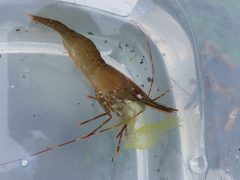
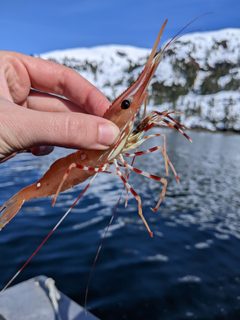
- Pandalus borealisOverlaps in North Pacific distribution and commercial importance; distinguished by P. platyceros having distinct white spots on first and fifth abdominal segments and banded
- Botan ebi (traditional Japanese shrimp)Marketed interchangeably in Japan; requires close examination of to distinguish, though flavor and texture are considered equivalent
More Details
Chemical Sensitivity
Post- individuals show greater sensitivity to azamethiphos-based chemotherapeutants than intermolt individuals. increases approximately 2.4-fold at 17°C compared to 5°C.
Tagging Viability
Coded wire tags injected in the thoracic sinus show 95% retention over 6 months with no significant effects on growth, survival, or through at least two .
Sources and further reading
- BugGuide
- Wikipedia
- GBIF taxonomy match
- iNaturalist taxon
- NCBI Taxonomy
- Catalogue of Life
- Evaluating vitality and predicting mortality in spot prawn, Pandalus platyceros, using reflex behaviors
- Agarum Kelp Beds as Nursery Habitat of Spot Prawns, Pandalus Platyceros Brandt, 1851 (Decapoda, Caridea)
- Agarum Kelp Beds as Nursery Habitat of Spot Prawns, Pandalus Platyceros Brandt, 1851 (Decapoda, Caridea)
- Tag Retention of the Spot Prawn, Pandalus platyceros, Injected With Coded Wire Tags
- The protandric life history of the Northern spot shrimp Pandalus platyceros: molecular insights and implications for fishery management
- Biological traits of the spot prawn Pandalus platyceros Brandt, 1851 (Decapoda, Caridea) at its southernmost distribution limit
- Concentrations of Inorganic Elements and Fatty Acids in Geographic Populations of the Spot Prawn Pandalus platyceros
- Lethal and sublethal effects of the anti‐sea lice formulation Salmosan® on the Pacific spot prawn (Pandalus platyceros)