
Pandalidae
Haworth, 1825
pandalid shrimp
Genus Guides
1- Pandalus(cold-water prawn)
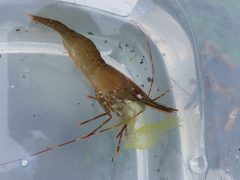
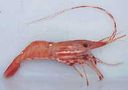
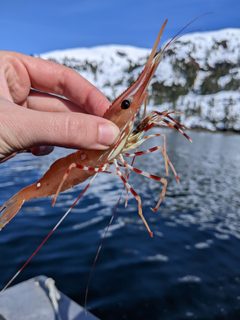
Pandalidae is a of caridean shrimp commonly known as pandalid shrimp, characterized by two distinctive morphological features: a subdivided carpus on the second pereiopod and the absence of chelae (claws) on the first pereiopod. Members of this family are predominantly cold-water , with tropical representation occurring primarily through deep-sea forms. The family holds significant commercial value, as many species are edible and support important fisheries. The Physetocaris, formerly included in Pandalidae, has been reclassified into its own family Physetocarididae.
Pronunciation
How to pronounce Pandalidae: /pænˈdælɪˌdaɪiː/
These audio files are automatically generated. While they are not always 100% accurate, they are a good starting point.
Identification
Pandalid shrimp can be distinguished from other caridean by the combination of two key characters: the carpus (wrist segment) of the second pereiopod is subdivided (multi-segmented), and the first pereiopod lacks chelae (claws). These features separate them from morphologically similar caridean families where either the second pereiopod carpus is undivided or the first pereiopod bears claws.
Images
Habitat
Primarily cold-water marine environments; tropical occur as deep-sea forms typically at depths of 200–2000 m. Benthic or nektobenthic lifestyle has been documented in some .
Distribution
Widespread distribution with concentration in cold temperate and waters; present in the North Atlantic (including New England waters, Scandinavia), North Pacific, and Southern Ocean. Deep-water extend into tropical regions of the Indo-West Pacific, Southwestern Atlantic (Central and South Brazilian coasts), and eastern Pacific off Mexico. Documented from the western Mediterranean Sea, Ligurian Sea, and Magellan Region of South America.
Life Cycle
Based on studies of Pandalus hypsinotus, some exhibit complex involving sex change (protandric hermaphroditism). Juveniles spend their first year at depths less than 70 m, then migrate deeper as they mature. Males develop first, with gender transition to hermaphroditic intersexes beginning around age 5–6 years, followed by to functional females. Females may undergo multiple reproductive cycles; in P. hypsinotus, a 2-year reproductive cycle has been proposed with total lifespan reaching 12–16 years and up to five spawning events. Larval hatching occurs in spring (April–May in studied ), with planktonic larval stages present in the water column.
Behavior
has been documented in at least one (Pandalus danae), involving use of specialized appendages for body cleaning.
Human Relevance
High economic value as food source; supports commercial trap and trawl fisheries. Multiple are targeted for human consumption.
Similar Taxa
- PhysetocarididaeFormerly included in Pandalidae but now recognized as a separate based on distinct morphological features
- Other caridean familiesLack the combination of subdivided carpus on second pereiopod and absence of chelae on first pereiopod that defines Pandalidae
Sources and further reading
- BugGuide
- Wikipedia
- GBIF taxonomy match
- iNaturalist taxon
- NCBI Taxonomy
- Catalogue of Life
- Distribution characteristics of pandalid shrimps (Decapoda: Caridea: Pandalidae) along the western Mediterranean Sea
- New species of Plesionika Bate, 1888 (Crustacea, Decapoda, Pandalidae) from Southwestern Atlantic
- Planktonic Larvae of Natantia (Decapoda) in Tigullio Gulf (Ligurian Sea), With Remarks On Larvae of Pandalidae
- Grooming behavior and morphology of the caridean shrimp Pandalus danae Stimpson (Decapoda: Natantia: Pandalidae)
- Note on the Distribution of Pandalidae (Crustacea, Decapoda) in New England Waters
- Egg production of Austropandalus grayi (Decapoda, Caridea, Pandalidae) from the Magellan Region, South America
- Taxonomy and Some Notes On the Biology of a New Caridean Shrimp, Plesionika Izumiae (Decapoda, Pandalidae)
- Plesionika sanctaecatalinae Wicksten, 1983 (Crustacea Decapoda Caridea Pandalidae) from off the west coast of Pacific Mexico
- An overview of the genus Plesionika Bate, 1888 (Decapoda, Caridea, Pandalidae) in Asian waters
- On features of the life cycle of humpback shrimp Pandalus hypsinotus (Decapoda, Pandalidae) in the Tatar Strait