
Pandalus
Leach, 1814
cold-water prawn
Species Guides
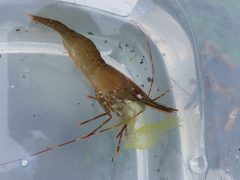
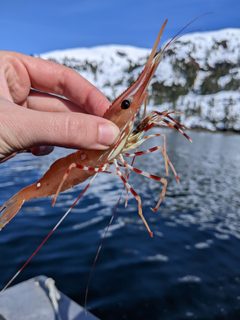
1- Pandalus platyceros(spot prawn)
Pandalus is a of medium-sized cold-water shrimp in the Pandalidae, inhabiting marine benthic environments primarily in northern seas. Members are protandric , beginning life as males and transitioning to females with age. Several support significant commercial fisheries, including P. borealis (northern shrimp), P. jordani (pink shrimp), and P. platyceros (spot prawn). The genus exhibits characteristic vertical diel and variable nursery associations across species.
Pronunciation
How to pronounce Pandalus: //pænˈdæləs//
These audio files are automatically generated. While they are not always 100% accurate, they are a good starting point.
Identification
Distinguished from other pandalid by combination of medium body size, cold-water distribution, and protandric hermaphroditism. Specific identification to level requires examination of rostral , ornamentation, and male pleopod . P. platyceros identifiable by white spotting pattern; P. goniurus by angled tail and smaller maximum size relative to other commercial species.
Images
Habitat
Marine benthic and demersal , occurring on or near the seabed at depths ranging from shallow coastal waters to over 400 m. Preferred substrates include silty grounds at 80–130 m depth for some . Nursery habitats vary: P. platyceros uses Agarum kelp beds as habitat in southern British Columbia. P. montagui associates with reef-building polychaete Sabellaria spinulosa. Diel vertical occur, with individuals concentrated near bottom during daylight and rising 8–60 m into water column at night.
Distribution
Cold-temperate and seas of the Northern Hemisphere. Documented from North Atlantic (including West Greenland, Norway, Sweden, Denmark), North Pacific (Sea of Okhotsk, Bering Sea, coastal British Columbia), and Arctic waters. Specific ranges vary by : P. borealis circumpolar in North Atlantic; P. goniurus in northern Sea of Okhotsk; P. platyceros in northeastern Pacific from Alaska to California.
Seasonality
Spawning occurs in spring (May–June in studied ). Settlement of juveniles primarily in May–June for P. platyceros, with extended settlement through summer. Larval duration in plankton 4–6 months. Lifespan typically 3–5 years, with sexual maturity reached at age 2 years in males.
Host Associations
- Sabellaria spinulosa - associationPandalus montagui lives in association with reef-building polychaete worm Sabellaria spinulosa
Life Cycle
Protandric hermaphroditism: all individuals begin life as males, function as males for 1–2 years, then transition to females. Males mature at approximately age 2 years. Sex change occurs at age 3–4 years in P. goniurus, with females living 2–3 additional years. internal; females carry 3,000 under for approximately 6 days before larval release. Eggs develop into planktotrophic larvae that remain in plankton 4–6 months with potential of at least 10 km. Rapid growth rate enables rapid recovery following disturbance.
Behavior
Strong vertical diel : concentrated in near-bottom layer during daylight, rising 8–10 m (maximum 60 m) into water column at night, apparently following prey. Forms dense single- ; daytime trawl catches may be 95% P. goniurus in some areas. Horizontal distribution unstable with varying by order of magnitude over several days. P. platyceros emigrate from kelp nursery starting in fall at 16–20 mm length; slower-growing individuals remain through winter.
Ecological Role
Important prey item in benthic and demersal ; specific not documented in sources. Commercial fishing target with significant economic value. High protein content (19.7% in P. goniurus) with very low fat content (0.1%). Shells processable into , chitosan, and derivatives. Microbial associated with shrimp body surfaces and viscera documented, with Proteobacteria predominant bacterial and Ascomycota in fungal communities.
Human Relevance
Major commercial fishery resource across multiple . Targeted by trawling fisheries in North Atlantic and North Pacific. Commercially exploited species include P. borealis (northern shrimp), P. jordani (pink shrimp), P. goniurus (angled-tailed/flexed shrimp), P. danae (dock shrimp), P. hypsinotus (humpback shrimp), P. montagui (pink shrimp), and P. platyceros (spot shrimp). Subject to image analysis techniques for automated length estimation to improve fishery assessment .
Similar Taxa
- Other Pandalidae generaPandalus distinguished by medium size, cold-water distribution, and protandric hermaphroditism; other may differ in size, thermal , or reproductive strategy
More Details
Fisheries characteristics
P. goniurus forms extremely dense single- , enabling efficient trawl capture. Stock status considered stable in northern Sea of Okhotsk with no concerns for near future.
Growth variability
Variable early and growth rates in P. platyceros lead to mixed age groups at given size classes, complicating age-based fishery assessments.
Sources and further reading
- BugGuide
- Wikipedia
- GBIF taxonomy match
- iNaturalist taxon
- NCBI Taxonomy
- Catalogue of Life
- The biology of Pandalus
- Exploring Diverse Microbial Community Associated With Pandalus Borealis by High-throughput Sequencing Technology and Traditional method
- The angled-tailed shrimp Pandalus goniurus is a promising fishing object in the northern part of the Sea of Okhotsk
- Northern Shrimp (Pandalus borealis) Recruitment in West Greenland Waters Part I. Distribution of Pandalus Shrimp Larvae in Relation to Hydrography and Plankton
- Estimation of shrimp (Pandalus borealis) carapace length by image analysis
- Discoloration of the Cephalothorax in Pandalus borealis and its Correlation with Internal Cadmium Concentration
- Agarum Kelp Beds as Nursery Habitat of Spot Prawns, Pandalus Platyceros Brandt, 1851 (Decapoda, Caridea)