
Armases cinereum
(Bosc, 1801)
squareback marsh crab, wharf crab
Armases cinereum is a small, dark brown crab native to Atlantic and Gulf coasts of North America. It inhabits intertidal zones from salt marshes to mangrove swamps, often found under rocks and debris. The is highly , consuming detritus, plant material, and small . It is notable for extensive mobility between marsh and upland , with females exhibiting wider ranging movements that may transport energy between .

Pronunciation
How to pronounce Armases cinereum: //ˈɑːr.məˌsiːz sɪˈnɪər.iːəm//
These audio files are automatically generated. While they are not always 100% accurate, they are a good starting point.
Identification
Distinguished from Sesarma and Sarmatium by laterally parallel margins creating square shape. Distinguished from other Armases by combination of equatorial smooth carapace, hair row on lower margin, and lack of on second legs. Sex can be determined by shape: males subtriangular with equilateral , females subcircular with telson wider than long.
Images
Appearance
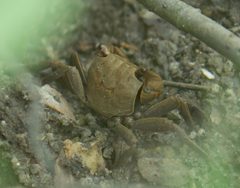
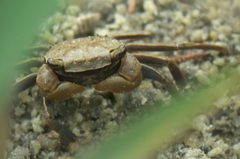
Small crab with dark brown to muddy coloration. is vertically compressed and square-shaped due to laterally parallel margins, slightly wider than long or vice versa. Distinct row of hair present on lower margin of carapace. Second legs lack . positioned on stalks at top of carapace. and positioned under carapace. Four walking legs per side with one claw per side positioned to legs. present: males slightly larger with more prominent palm; male abdomen subtriangular with equal in width and length, female abdomen subcircular with telson wider than long. Mature males 10.0–18.0 mm carapace length; mature females 11.0–17.2 mm.
Habitat
Intertidal zones of coastal environments, from subtidal to supratidal elevations. Found in Spartina salt marshes and Rhizophora mangrove swamps. Occurs among and under rocks, debris, and wrack deposited by tides. Can be found up to 50 meters inland from shore. Tolerates range of salinity conditions across marine-terrestrial .
Distribution
Western Atlantic Ocean: Chesapeake Bay south along Atlantic coast through Florida, west along Gulf of Mexico coast to Veracruz, Mexico. Present in temperate to tropical coastal zones.
Seasonality
Spawning occurs March through July. Active year-round in suitable climates with peak activity in warmer months.
Diet
Highly . Consumes partially decomposed leaves (especially Avicennia and other mangrove vegetation), fresh leaves of softer plants, insects, aphids, snails, other crabs, marsh sediments, and mammal . Prioritizes animal prey when available; prefers softer plant material over tougher vegetation when feeding on plants. Diet composition varies with local food availability.
Life Cycle
Ovigerous: females carry on during embryonic development. size 2,000–12,000 eggs, proportional to female size. Eggs hatch into planktonic zoea larvae with characteristic spine. Zoea undergo multiple , then transition to megalopa stage with on stalks, formed , and outward-positioned abdomen. Final molt produces crab resembling form.
Behavior
Highly mobile with bi-directional movement between salt marsh and upland forest . Females exhibit larger activity ranges spanning both marsh and forest; males prefer forest with more restricted ranges. Females feed preferentially in marshes and may transport energy landward as biotic . Males possess larger bodies and claws enabling consumption of larger and more diverse prey. Limb loss via injury is common.
Ecological Role
Key omnivore in mangrove and salt marsh , functioning as , herbivore, and . Links marsh and forest through movement, mediating energy fluxes along marine-terrestrial . Potential for spatial subsidies of energy from salt marsh to upland forest, particularly by females, though high metabolic rates limit net energy transfer. High local abundance makes it useful for studying trophic dynamics and as indicator of habitat conditions.
Human Relevance
Used as for coastal conditions due to high and sensitivity to environmental changes. Serves as research organism for studying trophic dynamics, metabolic , and marine-terrestrial connectivity in coastal .
Similar Taxa
- Sesarma spp.Similar and ; distinguished by non-parallel, more rounded margins lacking square shape
- Sarmatium spp.Similar ; distinguished by shape without parallel lateral margins
- Other Armases speciesSame ; distinguished by specific combination of proportions, hair patterns, and leg
More Details
Taxonomic history
Originally described as Sesarma cinereum by Louis Bosc in 1802; reclassified to Armases by Lawrence Able in 1992
Metabolic ecology
Field metabolic rates increase with body size and temperature; vitellogenic females have elevated metabolic rates. High energy expenditures reduce potential for energy transfer as spatial subsidies between .