
Pinnixa
White, 1846
pea crabs
Species Guides
1- Pinnixa chaetopterana(tube pea crab)
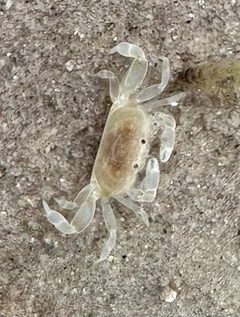
Pinnixa is a of small symbiotic crabs in the Pinnotheridae, commonly known as pea crabs. in this genus are obligate or facultative of various marine including bivalve mollusks, tube worms, ghost shrimp, and holothurians. The genus is characterized by a reduced rostrum, absence of teeth between the , and a compact adapted for living within structures. Multiple species have been documented across the Pacific and Atlantic coasts of the Americas and Asia.
Pronunciation
How to pronounce Pinnixa: //pɪˈnɪksə//
These audio files are automatically generated. While they are not always 100% accurate, they are a good starting point.
Identification
Distinguished from other pinnotherid by the combination of absent rostrum, lack of interorbital teeth, and specific proportions. -level identification requires examination of male abdominal structure and first ; some species pairs (e.g., P. faba and P. littoralis) are indistinguishable without magnification. Differences in outer orbit shape and cheliped gap when closed can separate certain species.
Images
Appearance
Small crabs with compact, often rounded . Carapace width typically under 15 mm. No rostrum present; no teeth between the . Carapace and legs frequently covered with setae that can collect filtered material from . Dactyl tips often curved. Outer eye orbits variable in shape between —rounded in some, more angular in others. Male and first provide key diagnostic characters for species identification.
Habitat
Marine environments; -specific associations with organisms. Found within mantle cavities of large bivalves (e.g., Tresus clams), burrows of thalassinid ghost shrimp, tubes of polychaete worms (Chaetopterus), and body cavities of holothurians. Occupies intertidal to shallow subtidal zones. Some species facultatively commensal, others appear obligate on specific hosts.
Distribution
Widespread in coastal marine waters of the Americas and Asia. Documented from Alaska to California (P. faba), northeastern Brazil (P. gracilipes), southern Brazil (P. patagoniensis), Chile (P. tumida), South Carolina (P. chaetopterana), and Japan (P. rathbuni, P. banzu). Specific ranges tied to distributions.
Seasonality
Ovigerous females observed October through March in at least one (P. patagoniensis). Recruitment patterns vary: bimodal recruitment with fall peak documented in some . Larval stages planktonic; megalopae transition to benthic existence before .
Diet
Feeds on organic matter filtered or processed by . In bivalve associates, consumes material collected by host filtering. In holothurian associates, likely utilizes host digestive products. Laboratory-reared larvae fed rotifers and diatoms.
Host Associations
- Tresus capax, Tresus nuttallii (bivalve mollusks) - Mature stage only; mating restricted to these
- Lepidophthalmus siriboia (thalassinid ghost shrimp) - ectosymbiontP. gracilipes; lives in association with burrows
- Sergio mirim (callianassid ghost shrimp) - P. patagoniensis; inhabits burrows
- Callichirus garthi (ghost shrimp) - P. valdiviensis
- Chaetopterus (parchment tube worms) - facultative commensalP. chaetopterana; also P. banzu with C. cautus
- Paracaudina chilensis (holothurian) - endosymbiontP. tumida; inhabits body cavity
Life Cycle
Development includes five zoeal stages and one megalopal stage, followed by to crab stage. Complete zoeal period averages approximately 24 days at 27°C in laboratory conditions for studied . Duration of individual zoeal stages varies (4–6 days per stage). Megalopa stage precedes settlement and . Juveniles of some species use different host species than .
Behavior
Symbiotic lifestyle with -specific fidelity in mature stages. In bivalve hosts, females typically remain in visceral folds feeding while males and juveniles roam the mantle cavity. Host switching has been documented in some . recognition influences host choice in at least one . Mating restricted to specific host species in some cases.
Ecological Role
Commensal or weakly parasitic . Generally causes minimal detectable damage to ; relationship sometimes characterized as commensalism. Serves as host for specialized nemertean (e.g., Carcinonemertes pinnotheridophila in branchial chambers). May influence host filtering rates or energy budgets, though effects typically subtle.
Human Relevance
No direct economic importance. P. faba occasionally encountered by clam harvesters in Pacific Northwest. Subject of ecological and research. Some indicators of health or quality.
Similar Taxa
More Details
Taxonomic complexity
identification within Pinnixa requires detailed examination of male genitalia and abdominal structure. Several species pairs are morphologically cryptic. Genetic studies have illuminated switching phenomena and clarified species boundaries in some regions.
Developmental plasticity
Laboratory rearing of P. gracilipes showed that megalopae may fail to complete to crab stage without appropriate -associated cues or shelter, suggesting host presence may influence developmental completion.
Host specificity variation
specificity varies considerably across the : some appear obligate on single host species for , while others are facultative commensals with broader host ranges. stages often show less host specificity than .
Sources and further reading
- BugGuide
- Wikipedia
- GBIF taxonomy match
- iNaturalist taxon
- NCBI Taxonomy
- Catalogue of Life
- Physiological ecology of the commensal crabs, Polyonyx gibbesi haig and Pinnixa chaetopterana stimpson
- Relationship between the pea crab Pinnixa tumida and its endobenthic holothurian host Paracaudina chilensis
- The larval development of Pinnixa gracilipes Coelho (Decapoda, Pinnotheridae) reared in the laboratory
- Redescription of Pinnixa Arenicola Rathbun, 1922 (Decapoda: Brachyura: Pinnotheridae), With New Observations on Its Range and Host
- A new species of Pinnixa (Crustacea: Decapoda: Brachyura: Pinnotheridae) associated with a tube worm, Chaetopterus cautus (Annelida: Polychaeta), from Tokyo Bay, Japan
- Population distribution, sexual dimorphism, and reproductive parameters in the crab Pinnixa valdiviensis Rathbun, 1907 (Decapoda: Pinnotheridae), a symbiont of the ghost shrimp Callichirus garthi (Retamal, 1975) in the southeastern Pacific
- Distribution of Larvae of Pinnixa rathbuni Sakai (Decapoda: Pinnotheridae) in Ise Bay and its Neighbouring Coastal Waters, Central Japan - IV. The Megalopic Larvae in a Benthic Existence
- Carcinonemertes pinnotheridophila sp. nov. (Nemertea, Enopla, Carcinonemertidae) from the branchial chambers of Pinnixa chaetopterana (Crustacea, Decapoda, Pinnotheridae): description, incidence and biological relationships with the host
- Conspecific Recognition and Host Choice in a Pea Crab, Pinnixa chaetopterana (Brachyura: Pinnotheridae)
- Carcinonemertes pinnotheridophila sp. nov. (Nemertea, Enopla, Carcinonemertidae) from the branchial chambers of Pinnixa chaetopterana (Crustacea, Decapoda, Pinnotheridae): description, incidence and biological relationships with the host
- Population Dynamics of Pinnixa patagoniensis Rathbun, 1918 Brachyura: Pinnotheridae a Symbiotic Crab of Sergio mirim Thalassinidea: Callianassidae in Cassino Beach, Southern Brazil
- Distribution of Larvae of Pinnixa rathbuni SAKAI (Decapoda: Pinnotheridae) in Ise Bay and Its Neighbouring Coastal Waters, Central Japan
- Biology of the brachyuran crab Pinnixa chaetopterana Stimpson (Decapoda: Pinnotheridae) symbiotic with tubicolous polychaetes along the Atlantic coast of the United States, with additional notes on other polychaete associations
- Genetic Analysis of Pea Crabs of the Genus Pinnixa White, 1846 (Brachyura: Pinnotheridae: Pinnixinae) Illuminate Their Taxonomy within the Subfamily and a Phenomenon of Host Switching in One of the Most Abundant Species in Vostok Bay, Sea of Japan