
Hemigrapsus sanguineus
(De Haan, 1835)
Asian shore crab, Japanese shore crab
Hemigrapsus sanguineus is a small intertidal crab native to the northwestern Pacific Ocean. It has become a highly successful in North America and Europe, first detected in New Jersey in 1988. The exhibits broad physiological , thriving across wide ranges of salinity and temperature. Its rapid growth and competitive superiority over native crabs have raised significant ecological concerns, though specificity for complex rocky shorelines may limit its impact in some systems.
Pronunciation
How to pronounce Hemigrapsus sanguineus: /ˌhɛmɪˈɡræpsəs sæŋˈɡwɪniəs/
These audio files are automatically generated. While they are not always 100% accurate, they are a good starting point.
Identification
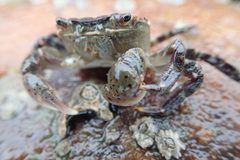
Distinguished from native Atlantic crabs by the squarish with three anterolateral spines per side and banded legs. Carcinus maenas (green crab) has five anterolateral spines and lacks leg banding. Hemigrapsus sexdentatus has six spines per side. The male claw bulb is diagnostic for H. sanguineus among sympatric . Juveniles may be confused with small mud crabs but show the characteristic spine count and banding pattern.
Images
Appearance
squarish in shape, approximately 35–50 mm in width in . Three distinct spines present on each anterolateral margin of the carapace. Pereiopods ( legs) marked with alternating light and dark bands. Males possess a bulb-like structure at the base of the movable finger on the claws, a sexually dimorphic trait. Overall coloration variable, typically mottled greenish to purplish-brown.
Habitat
Primarily inhabits rocky intertidal zones, particularly areas with complex structure such as boulder fields, cobble beaches, and mussel beds. Frequently occupies artificial structures including oyster reefs, breakwaters, and riprap. Can tolerate salt marsh and demonstrates euryhaline and eurythermic physiology, allowing persistence across estuarine salinity and temperature gradients.
Distribution
Native to coastal waters of the northwestern Pacific Ocean from Peter the Great Bay (Russia) to Hong Kong. Introduced to western Atlantic Ocean from Maine to North Carolina (first recorded 1988, New Jersey). Established in Europe from France to Scandinavia, including the English Channel, North Sea coasts of Germany and Denmark, and the Øresund. Single records from Mediterranean Sea (Adriatic) and Black Sea (Romania). Established in southern Australia (Port Phillip Bay, Victoria, since 2020).
Seasonality
Breeding females produce 3–4 annually. typically hatch in late summer or fall (August–October in northern hemisphere). Larvae are planktonic for 16–25 days through five zoeal stages and one megalopal stage before settlement. recruitment occurs primarily in late summer through fall. present year-round in suitable .
Diet
Opportunistic omnivore with demonstrated preference for animal prey over . Consumes small including mussels, snails, amphipods, and other crustaceans. Diet breadth increases with , suggesting diet shifts under competitive pressure. During starvation periods, food selectivity decreases.
Life Cycle
Females produce up to 50,000 per , with 3–4 broods annually. Eggs hatch into zoea larvae that develop through four additional zoeal stages and one megalopal stage over 16–25 days. Larvae are planktonic and capable of long-distance . Juveniles undergo five to reach megalopal stage, requiring approximately one month. Settlement and to benthic crab form follows. Total development from egg to crab approximately 6–8 weeks under favorable conditions.
Behavior
Exhibits (voluntary limb shedding) as anti- response, with subsequent limb . Regeneration effort increases with injury severity and progresses nonlinearly through the regeneration period. Larvae display negative geotaxis and responses to hydrostatic pressure that facilitate retention in estuarine waters. are aggressive competitors, frequently displacing native crabs from shelter and food resources. foraging activity common.
Ecological Role
function as intertidal consumers, potentially altering benthic structure through on native and competition with native crabs. Serves as prey for fish and birds in invaded ranges; some native fish populations have shifted to prefer H. sanguineus due to its abundance. Acts as intermediate for acanthocephalan including Polymorphus botulus. Natural enemy Sacculina polygenea (parasitic barnacle) is specific to this in native range.
Human Relevance
Significant of concern for coastal management in North America and Europe. Economic impacts include potential disruption of shellfisheries and native crab fisheries through competition. No effective mitigation measures currently available. Research model for invasion , optimal energy allocation theory, and limb studies.
Similar Taxa
- Carcinus maenasOverlapping range and ; distinguished by five anterolateral spines (vs. three), lack of leg banding, and more rounded carapace shape.
- Hemigrapsus sexdentatusNative to New Zealand; distinguished by six anterolateral spines per side (vs. three) and different claw .
- Hemigrapsus penicillatusCongeneric with overlapping native range; distinguished by setal tufts ('paintbrush') on claws and different ornamentation.
Sources and further reading
- BugGuide
- Wikipedia
- GBIF taxonomy match
- iNaturalist taxon
- NCBI Taxonomy
- Catalogue of Life
- Ticks Can Do More Than 'Tick You Off' | Bug Squad
- Encyrtid Holdings | Entomology Research Museum
- Issue #150 of PhytoKeys marks a decade of revolutionising open plant systematics | Blog
- Brown Dog Ticks are Resistant to Permethrin, Study Finds
- Optimal limb regeneration strategies in Hemigrapsus sanguineus
- Invasion biology of the Asian shore crab Hemigrapsus sanguineus: A review
- Hemigrapsus sanguineus (Decapoda, Grapsidae), a new intermediate host for Polymorphus botulus (Acanthocephala)
- Behavior of larval Hemigrapsus sanguineus (de Haan) in response to gravity and pressure
- Peer Review #1 of "Intertidal habitat complexity influences the density of the non-native crab Hemigrapsus sanguineus (v0.1)"
- Peer Review #2 of "Intertidal habitat complexity influences the density of the non-native crab Hemigrapsus sanguineus (v0.1)"
- Figure 2: Invasive rootlets of P. polygeneus in the nervous tissue of the host Hemigrapsus sanguineus .
- Peer Review #3 of "Physiological and behavioral response of the Asian shore crab, Hemigrapsus sanguineus, to salinity: implications for estuarine distribution and invasion (v0.2)"
- Peer Review #1 of "Physiological and behavioral response of the Asian shore crab, Hemigrapsus sanguineus, to salinity: implications for estuarine distribution and invasion (v0.1)"
- Peer Review #3 of "Physiological and behavioral response of the Asian shore crab, Hemigrapsus sanguineus, to salinity: implications for estuarine distribution and invasion (v0.1)"
- Peer Review #2 of "Physiological and behavioral response of the Asian shore crab, Hemigrapsus sanguineus, to salinity: implications for estuarine distribution and invasion (v0.1)"
- A population study of the Asian shore crab, Hemigrapsus sanguineus , at Point Judith Pond, RI
- A population study of the Asian shore crab, Hemigrapsus sanguineus , at Point Judith Pond, RI
- Are mussel beds a favourable habitat for settlement of Hemigrapsus sanguineus (De Haan, 1835)?
- Habitat and Diet of the Non-Native Crab Hemigrapsus sanguineus in Southeastern New England