
Callianassidae
Dana, 1852
Ghost Shrimps
Genus Guides
1- Neotrypaea(ghost shrimp)
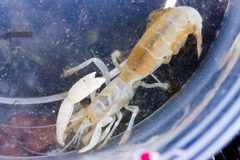
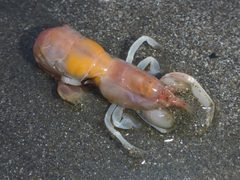
Callianassidae is a of burrowing decapod crustaceans commonly known as ghost shrimps, comprising 41 . Members are obligate burrowers in marine and estuarine sediments, with most inhabiting intertidal to shallow subtidal . The family has undergone significant taxonomic revision based on molecular phylogenetic studies, resulting in the establishment of numerous new genera. Ghost shrimps are ecologically important as engineers and are frequently encountered in the fossil record, primarily as preserved cheliped elements.
Pronunciation
How to pronounce Callianassidae: //ˌkæliəˈnæsɪdiː//
These audio files are automatically generated. While they are not always 100% accurate, they are a good starting point.
Images
Habitat
Marine and estuarine environments, primarily intertidal to shallow subtidal zones. construct burrows in sandy, muddy, or clayey sediments. Some species occur in deeper shelf waters. preferences vary by and species, with some restricted to estuaries and river mouths while others occupy coastal marine settings.
Distribution
in tropical to temperate coastal waters. Documented from the Indo-West Pacific, eastern Pacific, Atlantic, and Mediterranean. Specific distribution varies by ; some genera show regional . Fossil occurrences extend to the Oligocene and Miocene of Europe.
Life Cycle
Obligate burrowers throughout most of life. Development varies: some exhibit abbreviated larval development with large and reduced planktonic phases, while others have more extended larval stages. recruitment patterns observed seasonally in some species (e.g., February–May in Callichirus seilacheri). Sexual maturity size varies by species.
Behavior
Constructs and maintains complex burrow systems used for shelter, , and feeding. Burrow varies among . Hypoxia has been demonstrated in some species. Mating presumably occurs within burrows but has rarely been directly observed. Multiple paternity has been documented in at least one species.
Ecological Role
engineers that significantly modify sediment structure through burrowing activity. Influences structure in shallow water . Bioturbation affects nutrient cycling and sediment chemistry. Some have been observed to colonize aquaculture ponds, potentially impacting shrimp farming operations.
Human Relevance
Some colonize penaeid shrimp aquaculture ponds, where dense may affect farming operations. Frequently studied for their ecological role in coastal sediment dynamics.
Sources and further reading
- BugGuide
- Wikipedia
- GBIF taxonomy match
- iNaturalist taxon
- NCBI Taxonomy
- Catalogue of Life
- Multiple paternity in the thalassinidean ghost shrimp, Callichirus islagrande (Crustacea: Decapoda: Callianassidae)
- The hypoxia tolerance of the burrowing ghost shrimp Callianassa Australiensis Dana (Decapoda, Thalassinidea, Callianassidae)
- Population biology of the burrowing shrimp Callichirus seilacheri (Decapoda: Callianassidae) in northern Chile
- A new ghost shrimp of the genus Pugnatrypaea (Decapoda, Axiidea, Callianassidae) from the South China Sea
- Cheramus iranicus, a new species of ghost shrimp (Decapoda: Axiidea: Callianassidae) from the Persian Gulf, Iran
- Gilvossius chichijimaensis Sakai, 2015 (Crustacea: Decapoda: Axiidea: Callianassidae), a junior subjective synonym of Paratrypaea bouvieri (Nobili, 1904)
- Molecular phylogeny of the genus Lepidophthalmus (Decapoda, Callianassidae), with re-examination of its species composition
- Burrow morphology of the ghost shrimp Nihonotrypaea petalura (Decapoda: Thalassinidea: Callianassidae) from western Kyushu, Japan
- New records, one new genus and 21 new species of Callianassidae (Crustacea, Axiidea) from the Indo-West Pacific
- On the identities of Callianassa bouvieri Nobili, 1904, C. maldivensis Borradaile, 1904, and C. gravieri Nobili, 1905 (Crustacea: Decapoda: Callianassidae): a morphometric approach
- First record of Clausidium (Copepoda, Clausidiidae) from Brazil: a new species associated with ghost shrimps Neocallichirus grandimana (Gibbes, 1850) (Decapoda, Callianassidae)
- Designation of a neotype for Glypturus rabalaisae Sakai, 2011, a ghost shrimp from continental shelf waters of the northern Gulf of Mexico (Crustacea: Decapoda: Callianassidae)
- Ghost shrimp Calliax de Saint Laurent, 1973 (Decapoda: Axiidea: Callianassidae) in the fossil record: systematics, palaeoecology and palaeobiogeography
- Two new species of the genus Lepidophthalmus (Decapoda, Axiidea, Callianassidae) from coastal Pacific waters of Central America
- Larval Development of the Ghost Shrimp Callichirus Islagrande (Decapoda: Thalassinidea: Callianassidae) Under Laboratory Conditions