
Neotrypaea
Manning & Felder, 1991
ghost shrimp
Neotrypaea is a of ghost shrimp in the Callianassidae, established by Manning & Felder in 1991. The genus contains at least 16 recognized distributed across the Pacific coasts of North and South America and Asia. Species within this genus are characterized by pronounced in claw , particularly the development of enlarged master claws in males. They are obligate burrowers in marine and estuarine sediments, where they function as engineers through their bioturbation activities.
Pronunciation
How to pronounce Neotrypaea: /ˈniː.oʊ.trɪˈpiːə/
These audio files are automatically generated. While they are not always 100% accurate, they are a good starting point.
Identification
Distinguished from related ghost shrimp by the pronounced heterochely and specific claw , particularly the deep propodal notch in the master claw. Males can be identified by the disproportionately large master claws with elevated, notched manus and slender, hooked dactyl. Females possess smaller, less dramatically shaped master claws. -level identification requires examination of morphology, and uropod structure, and often molecular markers. Sympatric species such as N. californiensis and N. gigas can be distinguished by specific morphological and genetic characters.
Images
Appearance
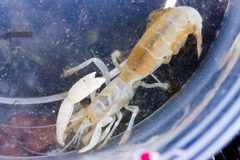
Body elongated and adapted for (burrowing) lifestyle, with reduced and a that is to the . Chelipeds (claws) show pronounced heterochely—one claw (the master claw) is greatly enlarged relative to the other (minor claw). In mature males of some , the master claw may approach 25% of total body weight, while in females it rarely exceeds 10%. Minor claws are less than 3% of body weight in both sexes. Master claws feature a deep propodal notch creating a large gape, with fine teeth along the periphery. Dactyl (movable finger) is slender and distally hooked in mature males. Pleopods reduced; uropods and form a tail fan used for backward burrowing locomotion. Overall coloration typically pale or translucent, consistent with subterranean existence.
Habitat
Marine and estuarine intertidal and shallow subtidal zones, exclusively in soft-sediment environments including sand, mud, and mixed substrates. Construct and inhabit complex burrow systems in saturated sediments. Some show substrate selectivity, with differential recruitment success to shell versus mud documented. Burrows extend from near the sediment surface to depths exceeding 1 meter in some .
Distribution
Pacific coast of North America from Alaska to Baja California (N. californiensis); Pacific coast of South America including Chile (N. uncinata); western Pacific including Japan (N. japonica), China (N. hainanensis, N. thermophila), and Russia (N. makarovi); eastern Pacific Rica (N. costaricensis) and Panama (N. tabogensis).
Seasonality
Spawning occurs during summer months, with documented periods from June to September in temperate . Larvae are ocean-borne and occurs during planktonic larval stages.
Host Associations
- Ione cornuta - parasitic castratorBopyrid isopod found in 5.8% of N. californiensis individuals in commercial trade; causes
Life Cycle
Complex with planktonic larval followed by benthic settlement and burrow construction. Spawning produces larvae that develop in coastal ocean waters before settlement in estuarine or marine sediments. Post-settlement survival varies by substrate type. Age can be estimated using lipofuscin concentration in neural tissue (increasing at ~1.43 ng µg⁻¹ year⁻¹) and gastric mill ossicular counts (~4.9 lamellae added per year), though size does not reliably indicate age.
Behavior
Obligate burrower constructing and maintaining permanent burrow systems. Hydraulic activities including active ventilation and irrigation of burrows induce oxic-anoxic oscillations in surrounding sediments, periodically oxygenating otherwise anoxic zones. Exhibits tide-related metabolic rhythms; in N. uncinata, oxygen consumption rate varies with tidal cycle (approximately 12.8 hour period matching semidiurnal tides), with elevated metabolic rates observed during low tide in non-acclimated individuals. Master claws function in stereotyped grappling during agonistic encounters and potentially during mating between similar-sized conspecifics.
Ecological Role
engineer through bioturbation; burrowing and ventilation activities modify sediment structure, porosity, and redox conditions. Influences local nitrogen cycling, with patchy distributions of denitrification and nitrogen fixation surrounding individual burrow systems. Creates heterogeneity that affects sediment chemistry and microbial composition. Can negatively impact shellfish aquaculture through burrowing activities that destabilize sediments and interfere with oyster .
Human Relevance
Used as live in recreational marine fisheries, with commercial harvest from Oregon and Washington transported to southern California markets. Considered a pest in oyster aquaculture operations in the Pacific Northwest due to sediment destabilization. Transport of live individuals poses risk of introducing associated (e.g., Ione cornuta) to regions where they are not native.
Similar Taxa
- CallianassaHistorically included now placed in Neotrypaea; distinguished by claw and structure
- LepidophthalmusOther callianassid ghost shrimp with different claw and typically tropical distribution
- N. gigasSympatric with N. californiensis in parts of the eastern Pacific; distinguished by molecular and morphological markers including specific claw and characteristics
More Details
Taxonomic history
now placed in Neotrypaea were formerly classified in Callianassa. The was erected by Manning & Felder in 1991 to accommodate species with distinctive morphological features. N. affinis is a synonym of N. biffari.
Genetic structure
Studies of N. californiensis show little phylogeographic structure across broad geographic ranges, suggesting high capability via planktonic larvae. However, significant temporal genetic differences can occur between larval cohorts, and estuarine may show genetic differentiation from offshore larval sources.
Sexual selection
The extreme in claw , particularly the elaborate master claws of males, appears to have evolved through . The grappling function suggested by claw morphology implies strong selection on male-male competition or female choice mechanisms.
Sources and further reading
- BugGuide
- Wikipedia
- GBIF taxonomy match
- iNaturalist taxon
- NCBI Taxonomy
- Catalogue of Life
- Interannual Differences in the Estuarine Ghost Shrimp, Neotrypaea californiensis
- Hydraulic activities by ghost shrimp Neotrypaea californiensis induce oxic−anoxic oscillations in sediments
- Evaluating risks associated with transport of the ghost shrimp Neotrypaea californiensis as live bait
- Genetic Population Structure and Cryptic Speciation of Ghost Shrimp (Neotrypaea californiensis) in North American West Coast Estuaries
- Denitrification and Nitrogen Fixation Dynamics in the Area Surrounding an Individual Ghost Shrimp (Neotrypaea californiensis) Burrow System
- Pronounced heterochely in the ghost shrimp, Neotrypaea californiensis (Decapoda: Thalassinidea: Callianassidae): allometry, inferred function and development
- Effects of substrate selection and post-settlement survival on recruitment success of the thalassinidean shrimp Neotrypaea californiensis to intertidal shell and mud habitats
- Assessing the relationship between a ghost shrimp Neotrypaea californiensis parasite and its potential fish host for natural biocontrol in shellfish aquaculture
- Tide-related biological rhythm in the oxygen consumption rate of ghost shrimp (Neotrypaea uncinata Milne Edwards)
- Molecular and Morphological Markers for Distinguishing the Sympatric Intertidal Ghost Shrimp Neotrypaea californiensis and N. gigas in the Eastern Pacific
- Verification of ageing methods for the burrowing shrimp, Neotrypaea californiensis, using extractable lipofuscin and gastric mill cuticular features
- Larvae of Sergestes arcticus Krøyer, 1855, Neotrypaea uncinata (H. Milne-Edwards, 1837), and Munida gregaria (Fabricius, 1793) between Seno Reloncaví and Boca del Guafo, southern Chile
- Physiological responses of the ghost shrimp Neotrypaea uncinata (Milne Edwards 1837) (Decapoda: Thalassinidea) to oxygen availability and recovery after severe environmental hypoxia