
Cambarus bartonii
(Fabricius, 1798)
common crayfish, Appalachian brook crayfish, Eastern Crayfish
Species Guides
1- Cambarus bartonii bartonii(Common Crayfish)
Cambarus bartonii is a freshwater crayfish native to eastern North America, first described from North America in 1798. It inhabits fast-flowing, cool, rocky streams and shallow lakes across a broad range from Ontario and New Brunswick south to Alabama. The exhibits notable physiological to acidic conditions and demonstrates behavioral flexibility, including documented use of terrestrial microhabitats for . Several have been proposed but their validity remains under investigation.
Pronunciation
How to pronounce Cambarus bartonii: //ˈkæm.bə.rəs ˈbɑːr.təˌnaɪ//
These audio files are automatically generated. While they are not always 100% accurate, they are a good starting point.
Identification
Plain dark brown coloration with occasional mottling or saddle-shaped marking distinguishes it from some sympatric . Secondary burrowing habit separates it from primary burrowing cambarids. In southern Appalachia, restricted to mountain and foothill streams, distinguishing it from lowland species. Form I males can be identified by reproductive . Antennules serve chemosensory function in feeding , a trait demonstrable through behavioral observation.
Images
Appearance
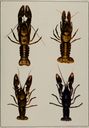
Typically plain dark brown in coloration, though occasional mottling or a saddle-shaped marking may be present. As a secondary burrowing crayfish, it possesses adaptations for both aquatic life and limited burrowing .
Habitat
Fast-flowing, cool, rocky streams and shallow lakes. Secondary burrowing crayfish capable of constructing limited burrows. Demonstrated ability to use terrestrial microhabitats, specifically decaying logs in forested areas, for .
Distribution
Eastern North America: Canadian provinces of Ontario, Quebec, and New Brunswick; United States from Maine to Alabama. In the southern portion of its range, restricted to the Appalachian Mountains and their foothills. Type locality thought to be near Philadelphia, Pennsylvania.
Behavior
Males of reproductive form (Form I) engage in agonistic contests with three main initiation acts: Lunge, Claws Raised, and Ambivalent Contact. Winners perform significantly more total initiation acts, Lunge, and Claws Raised than losers. Unlike some , eventual losers show limited submissive behavior and contest intensity does not decline with establishment of . Antennules serve critical chemosensory role in feeding behavior integration. Documented behavioral plasticity in use: capable of in terrestrial microhabitats including decaying wood.
Ecological Role
Essential constituent in maintaining freshwater . Serves as indicator of groundwater and ecosystem health in applicable contexts.
Human Relevance
Listed as Least Concern on IUCN Red List. Listed as of Special Concern in Connecticut. Subject of ecological research due to acid and behavioral studies. First crayfish described from North America, holding historical significance in North American carcinology.
Similar Taxa
- Cambarus robustusClosely related with which C. bartonii has been directly compared in agonistic contest studies; differs in contest dynamics including greater role of Lunge and more pronounced submission in losers during intraspecific contests.
- Cambarus bartonii carinirostrisRecognized (validity under investigation) known as Rock Crawfish; distinguished by geographic separation in northern West Virginia and potentially by morphological features implied by the subspecific epithet.
More Details
Subspecies Status
Several of C. bartonii have been recognized, but the advisability of this is unclear. Ongoing work seeks to determine patterns of infraspecific variation.
Acid Tolerance
Exhibits considerable physiological to acidity; 96-hour LC50 values of pH 2.43-2.85 depending on life stage. Lower water temperatures increase acid tolerance. Occasional acid episodes in southern Appalachian streams are not necessarily lethal, though chronic acidification could cause sublethal effects on and sensitive life stages.
Sources and further reading
- BugGuide
- Wikipedia
- GBIF taxonomy match
- iNaturalist taxon
- NCBI Taxonomy
- Catalogue of Life
- Small, rare crayfish thought extinct is rediscovered
- Observation of a Cambarus bartonii bartonii (Common Crayfish) Overwintering in a Terrestrial Winter Microhabitat
- Life history of Cambarus bartonii carinirostris in northern West Virginia.
- Response of the crayfish Cambarus bartonii bartonii to acid exposure in southern Appalachian streams
- AGONISTIC CONTESTS IN MALE FORM I CAMBARUS BARTONII BARTONII (FABRICIUS, 1798) (DECAPODA, CAMBARIDAE) CRAYFISH AND A COMPARISON WITH CONTESTS OF THE SAME TYPE IN CAMBARUS ROBUSTUS GIRARD, 1852
- Chemosensory Role of Antennules in the Behavioral Integration of Feeding by the Crayfish Cambarus bartonii
- Identification of Microbiota Associated with the Ectosymbiotic Community Structure of the Appalachian Brook Crayfish (Cambarus bartonii)
- CHEMOSENSORY ROLE OF ANTENNULES IN THE BEHAVIORAL INTEGRATION OF FEEDING BY THE CRAYFISH CAMBARUS BARTONII