
Cambarus robustus
Girard, 1852
Big Water Crayfish, robust crayfish
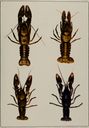
Cambarus robustus, commonly known as the Big Water Crayfish or robust crayfish, is a freshwater crayfish in the Cambaridae. It is native to eastern North America, ranging from several U.S. states to Ontario, Canada. The species has been studied extensively as a surrogate for federally endangered crayfish species due to its close phylogenetic relationships and similar ecological requirements. Research indicates it demonstrates significant acid compared to sympatric Orconectes species, exhibits complex agonistic with distinct initiation acts predicting contest outcomes, and occupies a partitioned trophic position in multi-species crayfish .
Pronunciation
How to pronounce Cambarus robustus: /kæmˈbɛərəs roʊˈbʌstʊs/
These audio files are automatically generated. While they are not always 100% accurate, they are a good starting point.
Identification
Distinguished from by its relatively large size and association with larger stream (hence "Big Water Crayfish"). Males exhibit two distinct reproductive forms: Form I (breeding) with enlarged, hardened and hooks on ischia; Form II (non-breeding) with reduced gonopods. Sexual maturity occurs at approximately 30.8mm total length in males and 37.3mm in females. Morphologically similar to and historically confused with members of the C. robustus complex, which has been revised to recognize three distinct (C. guenteri, C. taylori, C. hazardi) in the Kentucky and Licking River basins based on genetic, morphological, and zoogeographic differences.
Images
Habitat
Freshwater streams and rivers, particularly runs with large slab rocks embedded in gravel where females shelter. Demonstrates broad shelter use including natural substrates and artificial structures. Shows exceptional to low pH conditions (surviving at pH 4 in soft water) compared to sympatric crayfish , enabling persistence in acid-stressed lakes and streams.
Distribution
Eastern North America: native to several eastern U.S. states and Ontario, Canada. Documented from Vermont, West Virginia, Kentucky, and southwestern Ontario (Eramosa-Speed River system). Historical range included the Kentucky and Licking River basins, though this region has undergone taxonomic revision with recognition of cryptic .
Diet
opportunistic feeder. Stable isotope analysis indicates trophic partitioning from sympatric Cambarus carinirostris and Faxonius obscurus, with C. robustus occupying an intermediate trophic position between these in Kings Creek, West Virginia. Diet composition distinct from F. obscurus, which holds the highest trophic position among the three species.
Life Cycle
Sexual maturity at 30.8mm TCL (males) and 37.3mm TCL (females). involves -bearing (ovigerous) females; single documented clutch contained 94 eggs. females shelter beneath large slabs in gravel runs. Juveniles demonstrate ontogenetic dietary shifts, occupying lower than based on stable isotope signatures.
Behavior
Exhibits pronounced agonistic with three main initiation acts during contests: Lunge (highly aggressive), Claws Raised (aggressive), and Ambivalent Contact (tentative). In Form I male contests, winners use predominantly Lunge and Claws Raised behaviors while losers rely on Ambivalent Contact. Lunge frequency negatively correlates with total fighting time, indicating rapid establishment of . First fight initiators are predominantly eventual losers (81.5% of contests). Form II males show similar behavioral patterns but with quantitative differences in contest dynamics. Uses diverse shelter types including natural rock and artificial substrates, with preference for natural materials.
Ecological Role
engineer and in freshwater ecosystems. Contributes to structure through diet partitioning with sympatric crayfish , reducing competitive overlap. Acid allows persistence in degraded where other crayfish species cannot survive, maintaining ecological function in stressed systems.
Human Relevance
Serves as critical surrogate for husbandry and research on federally endangered crayfish, specifically Cambarus callainus (Big Sandy Crayfish) and C. veteranus (Guyandotte River Crayfish). Research on C. robustus has generated protocols for shelter requirements, temperature , and propagation techniques applicable to conservation of imperiled . Not listed as threatened; IUCN status Least Concern () as of 2010 review.
Similar Taxa
- Cambarus bartonii bartoniiClosely related with similar agonistic repertoire but differs in contest dynamics: C. bartonii losers are less submissive in intraspecific contests and lack the rapid decline in fighting intensity seen in C. robustus dominance establishment
- Cambarus carinirostrisSympatric in Kings Creek, West Virginia; occupies lower trophic position based on stable isotope analysis, demonstrating diet partitioning
- Faxonius obscurusSympatric in some ; occupies higher trophic position than C. robustus, feeding on distinct food sources
- Orconectes rusticus / O. propinquusSympatric in Ontario; far more sensitive to low pH (toxic at pH 5.4-6.1 in soft water) whereas C. robustus survives at pH 4, enabling partitioning in acid-stressed waters
- Cambarus guenteri / C. taylori / C. hazardiFormerly included in C. robustus complex; recently described as distinct based on genetic, morphological, and zoogeographic criteria in Kentucky and Licking River basins
More Details
Surrogate Species Value
C. robustus has been explicitly designated as a surrogate for federally listed Cambarus callainus and C. veteranus due to phylogenetic proximity and similar ecological requirements, enabling development of conservation protocols without direct disturbance of endangered .
Acid Tolerance Mechanism
Superior acid compared to Orconectes appears linked to physiological differences augmented by characteristics, specifically the ability of stage III juveniles to and survive at pH 4 in soft water where congenerics experience mortality.
Agonistic Behavior Predictive Value
Initiation serve as reliable predictors of contest outcomes: Lunge and Claws Raised behaviors strongly indicate eventual status, while Ambivalent Contact predicts subordinate status, with predictive power established from contest onset.
Sources and further reading
- BugGuide
- Wikipedia
- GBIF taxonomy match
- iNaturalist taxon
- NCBI Taxonomy
- Catalogue of Life
- Grasshoppers of Colorado
- ID Challenge #22: The Bone Collector | Beetles In The Bush
- Skulls on my desk | Beetles In The Bush
- Europe’s very own dinosaurs – the enigmatic rhabdodontids
- Small, rare crayfish thought extinct is rediscovered
- Invasive crayfish can cause high fisheries damage | Blog
- Shelter Use in Cambarus robustus, a Surrogate Species for the Federally Listed Cambarus callainus and Cambarus veteranus
- Analysis of Stable Isotopes for Cambarus carinirostris, Cambarus robustus, and Faxonius obscurus in Kings Creek.
- The Life History and Observational Notes On Cambarus robustus
- Trophic Partitioning of Cambarus carinirostris, Cambarus robustus, and Faxonius obscurus in Kings Creek, WV by Stable Isotope Analysis
- Initiation and Outcome of Agonistic Contests in Male Form i cAmbarus Robustus Girard, 1852 Crayfish (Decapoda, Cambaridae)
- Life History of Cambarus Robustus Girard in the Eramosa-Speed River System of Southwestern Ontario, Canada (Decapoda, Astacidea)
- AGONISTIC CONTESTS IN MALE FORM I CAMBARUS BARTONII BARTONII (FABRICIUS, 1798) (DECAPODA, CAMBARIDAE) CRAYFISH AND A COMPARISON WITH CONTESTS OF THE SAME TYPE IN CAMBARUS ROBUSTUS GIRARD, 1852
- Agonistic Interactions in Male Form Ii Cambarus Robustus Girard, 1852 Crayfish (Decapoda, Cambaridae) and a Comparison Between Male Form i aNd Form Ii Intra-Form Contests
- Variation in tolerance to low environmental pH by the crayfish Orconectes rusticus, O. propinquus, and Cambarus robustus
- A case of Appalachian endemism: Revision of the Cambarus robustus complex (Decapoda: Cambaridae) in the Kentucky and Licking River basins of Kentucky, USA, with the description of three new species