
Pagurus samuelis
(Stimpson, 1857)
blueband hermit crab
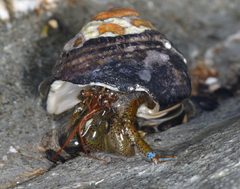
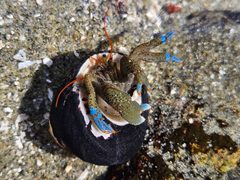
A small intertidal hermit crab native to the eastern Pacific coast, distinguished by bright blue bands on the legs of . It is the most common hermit crab in California. The exhibits strong shell fidelity, preferentially occupying shells of the black turban snail (Tegula funebralis). Behavioral studies demonstrate that shell acquisition takes priority over feeding when both resources are scarce, and that social isolation heightens aggressive and dominance in shell competition.
Pronunciation
How to pronounce Pagurus samuelis: /pəˈɡʊrəs sæmˈjuːɛlɪs/
These audio files are automatically generated. While they are not always 100% accurate, they are a good starting point.
Identification
Distinguished from similar hermit crabs by the combination of small size, bright blue bands on leg tips (white in juveniles), red , and triangular rostrum. Most readily confused with Pagurus hirsutiusculus, which lacks the distinctive blue leg bands and has different preferences. Shell choice provides additional clue: P. samuelis strongly prefers Tegula funebralis shells, whereas may occupy different gastropod shells.
Images
Appearance
Small hermit crab reaching up to 40 mm total length and 19 mm width. Base coloration of is brown or green. are red. display distinctive bright blue bands near the tips of the legs; in smaller individuals these bands may appear white. Legs and carapace covered in setae. Rostrum at front of carapace is triangular.
Habitat
Rocky intertidal zones along the eastern Pacific coast. Specifically associated with containing abundant Tegula funebralis shells. Found from the low intertidal to shallow subtidal zones.
Distribution
Eastern Pacific Ocean from Alaska to Punta Eugenia, Baja California, Mexico. Formerly misreported from Japan; those specimens now recognized as Pagurus filholi. Core abundance in California waters.
Seasonality
Breeding occurs May through July. Nocturnally active year-round in appropriate .
Diet
scavenger feeding primarily on , especially giant kelp (Macrocystis pyrifera), and carrion/detritus. Can survive on Pelvetia canaliculata in laboratory settings.
Host Associations
- Tegula funebralis - shell providerStrongly preferred gastropod shell; crabs will occupy other shells when unavailable
Life Cycle
produced May–July, carried on female's inside shell. Males carry females on their backs during breeding season, sometimes for more than 24 hours. Developmental stages typical of decapod crustaceans with planktonic larval phases, though specific details not well documented.
Behavior
scavenger. Exhibits pronounced behavioral plasticity in response to resource deprivation: shell-less individuals show heightened motivation to acquire shells, making fewer investigative contacts and faster decisions than non-deprived crabs. When simultaneously starved and shell-less, prioritizes shell acquisition over feeding. Social isolation increases high-ranking aggressive , dominance, and decisiveness in shell competition while reducing locomotory activity. Fear behavior shows biphasic response to isolation (initial decrease, then increase above baseline).
Ecological Role
Scavenger and in rocky intertidal . Prey for pile perch (Rhacochilus vacca), California sheephead (Semicossyphus pulcher), and spotted kelpfish (Gibbonsia elegans). Potential bioindicator for heavy metal based on differential metal accumulation patterns, though conclusive indicator status not established.
Human Relevance
Common subject of behavioral research due to accessibility and tractability in laboratory settings. Not of direct commercial importance. Provides service as scavenger in coastal environments.
Similar Taxa
- Pagurus hirsutiusculusOverlapping range and similar size; distinguished by lack of blue leg bands, hairier appearance, and different microhabitat preferences
- Pagurus filholiFormerly confused with P. samuelis; Japanese specimens previously misassigned to this
Sources and further reading
- BugGuide
- Wikipedia
- GBIF taxonomy match
- iNaturalist taxon
- NCBI Taxonomy
- Catalogue of Life
- Amazing Story About What Entomologist Lynn Kimsey Recorded in San Francisco Bay 50 Years Ago | Bug Squad
- Lycaeides-melissa-samuelis - Entomology Today
- Lycaeides melissa samuelis Archives - Entomology Today
- Wisconsin Butterfly Conservation Program Could Be a Model for Future Efforts
- Marine invertebrates with Cornwall Wildlife Trust - Buglife Blog - Buglife
- A Brief Guide to Pesticide Mitigations, Label Changes to Protect Endangered Species
- Influence of motivation on behaviour in the hermit crab, Pagurus samuelis
- Effect of isolation on components of aggressive and other behavior in the hermit crab, Pagurus samuelis
- Behavioral Patterns And Derived Hierarchy In Shell Fighting Among Hermit Crabs Pagurus Samuelis (Stimpson, 1857)
- Behavioral responses to burial in the hermit crab, Pagurus samuelis: Implications for the fossil record
- An investigation of population dynamics, individual behavior and learning capacity of Pagurus samuelis of Carmel Bay, California
- Heavy metals in the blueband hermit crab, Pagurus samuelis (Stimpson, 1857) (Decapoda: Anomura: Paguridae), from two Southern California habitats