
Paguridae
Latreille, 1802
Pagurid Hermit Crabs
Genus Guides
1Paguridae is a of marine hermit crabs within the order Decapoda, comprising over 542 across more than 70 . Members are characterized by their asymmetrical adapted to occupy empty gastropod shells for protection. The family exhibits remarkable diversity in range, from intertidal zones to deep-sea environments exceeding 700 meters depth. King crabs (family Lithodidae) are now understood to have evolved from within Paguridae, representing a derived lineage that secondarily lost shell-carrying .
Pronunciation
How to pronounce Paguridae: /pəˈɡʊrɪdiː/
These audio files are automatically generated. While they are not always 100% accurate, they are a good starting point.
Identification
Distinguished from other hermit crab (Coenobitidae, Diogenidae, Parapaguridae, Pylochelidae) by specific and gill ; precise identification requires examination of branchial structure and antennal . Shell-occupying distinguishes Paguridae from Lithodidae (king crabs), which evolved from pagurid ancestors but abandoned shell use. -level identification relies on cheliped morphology, structure, and male characteristics.
Images
Appearance
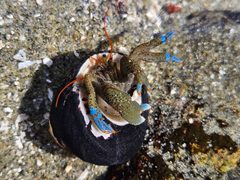
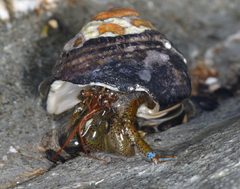
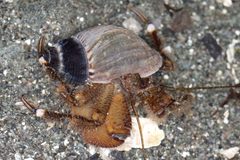
Asymmetrical curved to fit coiled gastropod shells; reduced or absent calcification of abdominal . Right cheliped typically larger than left, though asymmetry varies among . Long and antennules with sensory functions. shield-shaped anteriorly. Soft, unprotected abdomen requires external shelter. in pleopod structure: females possess four pairs of biramous pleopods for , males typically have unpaired or reduced pleopods.
Habitat
Marine environments spanning intertidal rocky pools, sandy substrates, coral reef crevices, and deep-sea benthos. Some occupy unique microhabitats: Pteropagurus species inhabit empty pteropod shells at 285–700 meter depths. Intertidal occur in pebble-covered shorelines and rock pools; sublittoral populations found on sandy substrates to at least 5 meters. Cryptic reef support diverse micro-pagurid . No terrestrial representatives in this .
Distribution
Worldwide in marine waters; Atlantic, Pacific, and Indian Ocean basins. Specific documented locations include: Japan (Hokkaido Sea of Japan coast, Chiba Pacific coast, Hakodate Bay); British Isles (Gower Peninsula, South Wales); Caribbean Sea and Gulf of Mexico (Bocas del Toro Panama, Guadeloupe, Louisiana, Yucatán, Florida Keys); New Caledonia (deep-water pteropod shell ); Canary Islands (southern range extension for Pagurus chevreuxi); Red Sea coral reefs. Pacific diversified from Atlantic lineages approximately 25–51 million years ago.
Seasonality
Reproductive seasonality varies by and latitude. Pagurus nigrofascia in northern Japan shows ovigerous females April through February with main spawning in May. Pagurus bernhardus exhibits influx of large males from sublittoral zones during breeding season. No evidence of tidal or seasonal in some intertidal , though other species show tidally and seasonally migratory .
Host Associations
- Peltogasterella gracilis - Rhizocephalan barnacle; induces morphological feminization in male Pagurus lanuginosus
- Peltogaster sp. - Rhizocephalan barnacle; induces morphological feminization in male Pagurus filholi
- Peltogaster postica - Rhizocephalan barnacle; variable feminization effects on Pagurus nigrivittatus and Pagurus japonicus
- Peltogaster aff. ovalis - Rhizocephalan barnacle; -specific effects on
- Gastropod shells - Occupied as protective shelter; shell availability influences growth, , and
- Pteropod shells - Unique deep-water for Pteropagurus at 285-700m depths
Life Cycle
Development includes planktonic larval stages (zoea, megalopa) before settlement and shell acquisition. Post-larval hermit crabs require gastropod shells immediately upon . Growth occurs through molting; increments influenced by shell size availability. Longevity estimates: up to 3 years for intertidal Pagurus bernhardus, 5 years for sublittoral . Recruitment timing varies; some populations show of small individuals with spring growth initiation. incubation duration highly variable: Pagurus nigrofascia exhibits 9-month incubation spanning summer and winter conditions.
Behavior
Obligate shell-carrying for protection; shell exchange occurs as individuals grow. Tactile communication documented in social interactions. Some exhibit site fidelity with no tidal or seasonal ; others show tidally and seasonally migratory patterns. Precocious puberty in small individuals facilitates high reproductive output. Shell fighting and assessment behaviors documented. Deep-sea species may exhibit filter-feeding postures. Potential cleaner or den commensalism with moray eels suggested for some Caribbean species but requires confirmation.
Ecological Role
Significant component of marine benthic ; densities up to 80 individuals per square meter in rock pools, locally exceeding 800 per square meter. Shell occupation creates for epizoic organisms (, hydroids, barnacles). Prey for fish, octopuses, and other . Rhizocephalan alters through . Nutrient cycling through scavenging and detrital feeding. Micro-pagurids contribute to cryptic reef biodiversity.
Human Relevance
Research model for crustacean development, shell selection , and - interactions. for marine health and shell availability. Some support small- fisheries. Taxonomic interest due to evolutionary relationship with commercially important king crabs. Subject of extensive ecological and behavioral research.
Similar Taxa
- Lithodidae (king crabs)Evolved from within Paguridae; distinguished by complete calcification, loss of shell-carrying , and robust body form
- ParapaguridaeDeep-sea hermit crabs; distinguished by modified gill structure and association with hexactinellid sponges rather than gastropod shells
- Diogenidae (left-handed hermit crabs)Left cheliped typically larger than right; different gill and antennal
- Coenobitidae (terrestrial hermit crabs)Terrestrial and semi-terrestrial ; modified gills for air breathing
More Details
Evolutionary significance
Molecular phylogenetic studies indicate Paguridae is with respect to Lithodidae; king crabs represent a derived pagurid lineage that abandoned shell use and evolved complete abdominal calcification. This evolutionary transition is among the most well-documented examples of major morphological innovation in decapods.
Parasite-induced feminization
Rhizocephalan barnacle causes -specific morphological feminization in male hermit crabs, including development of female-specific pleopods and reduced cheliped size. Effect magnitude varies by - combination, indicating complex coevolutionary dynamics.
Shell relationship
Shell availability is a critical limiting factor; shell size directly influences growth rate, reproductive timing, and structure. Shell epizoite differ between intertidal and sublittoral populations even when genetics are identical.
Sources and further reading
- BugGuide
- Wikipedia
- GBIF taxonomy match
- iNaturalist taxon
- NCBI Taxonomy
- Catalogue of Life
- Zookeys | Blog - Part 28
- Reproductive biology of the hermit crab Pagurus nigrofascia (Anomura: Paguridae)
- Diversity and Molecular Phylogeny of Pagurid Hermit Crabs (Anomura: Paguridae: Pagurus)
- Morphological feminization in the hermit crabs (family Paguridae) induced by the rhizocephalan barnacles
- Sexual Behavior of the Hermit Crab Pagur Us Traversi (Filhol) (Decapoda, Paguridae)
- Morphological feminization in hermit crabs (family Paguridae) induced by parasitic peltogastrid barnacles (Crustacea: Cirripedia: Rhizocephala)
- Ecological studies on two species of hermit crabs Pagurus bemhardus (L.) and Diogenes pugilator (Roux) (Crustacea, Anomura, Paguridae) around the Gower Peninsula, South Wales
- Southernmost record of Pagurus chevreuxi (Decapoda, Anomura, Paguridae) off the Canary Islands
- A new species of Solitariopagurus from the Red Sea with notes on S. profundus (Crustacea: Decapoda: Paguridae)
- New and rare micro-pagurid hermit crabs (Crustacea: Anomura: Paguridae) from the Caribbean Sea and Gulf of Mexico
- Tactile Stimuli in the Social Behavior of Pagurus Bernhard Us (Decapoda, Paguridae)
- A new genus with two new species of hermit crabs (Crustacea, Decapoda, Paguroidea, Paguridae) from an unique habitat