
Pagurus hirsutiusculus
(Dana, 1851)
Pacific Hairy Hermit Crab, Hairy Hermit Crab
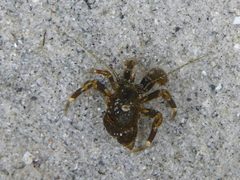
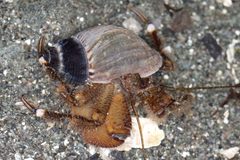
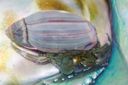
Pagurus hirsutiusculus is a small marine hermit crab found along the North Pacific coast from Alaska to California and Japan. reach up to 70 mm body length in northern , with southern populations being smaller and less hairy. The is distinguished by dense body hair, white and blue bands on legs, and grayish-brown with white bands. It inhabits the intertidal zone to depths of 110 m, commonly occupying empty gastropod shells for protection.
Pronunciation
How to pronounce Pagurus hirsutiusculus: /pəˈɡʊrəs hɜrsˌtuːiˈʌskjələs/
These audio files are automatically generated. While they are not always 100% accurate, they are a good starting point.
Identification
Distinguished from co-occurring hermit crabs by the combination of dense body hair and banded appendages. Pagurus samuelis occurs higher in the intertidal and lacks the extensive hair covering. The white and blue leg bands and white-banded are diagnostic. Southern (below Puget Sound) are less hairy and smaller, historically recognized as P. h. venturensis. The enlarged right cheliped and smaller left cheliped with calcium-sensitive setae are additional identifying features.
Images
Habitat
Marine; intertidal zone to subtidal depths of 110 m. Found in tide pools with sand or rock substrate, under rocks, logs, and seaweed. Occupies crevasses on bedrock and cobbled areas. In British Columbia, occurs from water line to approximately 2.5-3 m above Canadian chart datum. Generally occurs lower in the intertidal than Pagurus samuelis. Common in San Francisco Bay.
Distribution
North Pacific: Pribilof Islands, Alaska to southern California; Bering Strait south to Japan. East Pacific and Indo-West Pacific regions. Core range includes British Columbia, Washington, Oregon, and California coasts.
Diet
Primarily detritivorous; opportunistic feeder consuming seaweeds and other available organic material.
Host Associations
- Eremitione giardi - Bopyrid isopod inhabiting branchial chamber, feeding on
- Peltogasterella sp. - Colonial rhizocephalan parasitic barnacle
- Peltogaster sp. - Rhizocephalan parasitic barnacle with internal root system and external reproductive externa; can manipulate physiology
- Liriopsis pygmaea - hyperparasiteHyperparasite of Peltogaster sp.
Life Cycle
Ovigerous females carry visible clutch on . Larval development includes planktonic stages. Peltogaster sp. has dispersive larval stages and several invasion stages of single . Eremitione giardi parasite involves intermediate host (likely copepod) and two separate free-living larval stages.
Behavior
Occupies abandoned gastropod shells for protection; shell selection aided by calcium-sensitive setae on minor chela. Individuals from calmer waters readily abandon shells when disturbed by . observed in captivity. Emerges from shells when disturbed.
Ecological Role
contributing to nutrient cycling. for multiple including rhizocephalans and bopyrid isopods; parasite may mediate host and responses to environmental stress. Infected individuals show reduced following heat stress compared to uninfected individuals.
Human Relevance
Common subject of intertidal ecological studies. Baseline data from 1970-1971 San Francisco Bay survey used to assess long-term biodiversity shifts and impacts. Shell preference studies inform understanding of gastropod shell availability and hermit crab dynamics.
Similar Taxa
- Pagurus samuelisCo-occurs in intertidal zone but occupies higher tidal levels; lacks dense body hair and distinctive leg banding pattern of P. hirsutiusculus
- Pagurus hirsutiusculus venturensisFormerly recognized for southern below Puget Sound; distinguished by reduced hairiness and smaller body size
More Details
Shell preferences
Readily accepts shells of Nassa, Olivella biplicata, Nucella emarginata, Tectarius striatus, Epitonium tinctum, Alia carinata, Homalopoma luridum, Ilyanassa obsoleta, Urosalpinx cinerea, and Busycotypus canaliculatus
Climate sensitivity
Peltogaster sp. declined at some locations following 2021 Pacific Northwest heat wave; infected show reduced thermal
Research history
Documented in 1970-1971 baseline survey of San Francisco Bay intertidal by Lynn Kimsey; data now used as legacy dataset for assessing biodiversity change
Sources and further reading
- BugGuide
- Wikipedia
- GBIF taxonomy match
- iNaturalist taxon
- NCBI Taxonomy
- Catalogue of Life
- Amazing Story About What Entomologist Lynn Kimsey Recorded in San Francisco Bay 50 Years Ago | Bug Squad
- Marine invertebrates with Cornwall Wildlife Trust - Buglife Blog - Buglife
- Marine biology | Blog - Part 2
- Parasites of the hermit crab Pagurus hirsutiusculus; distribution, prevalence, and thermal ecology.