
Petrolisthes eriomerus
Stimpson, 1871
flattop crab
Petrolisthes eriomerus, commonly called the flattop crab, is a small porcelain crab inhabiting the eastern Pacific coast of North America. It reaches 20 mm in width and exhibits a distinctly flattened, rounded body form adapted for life under rocks and in crevices. The employs filter feeding and deposit sweeping to consume diatoms and organic material. It displays notable social , including and ritualized agonistic interactions between individuals.
Pronunciation
How to pronounce Petrolisthes eriomerus: //pɛtroʊˈlɪsθiːz ɛˌraɪoʊˈmɛrəs//
These audio files are automatically generated. While they are not always 100% accurate, they are a good starting point.
Identification
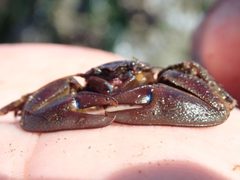
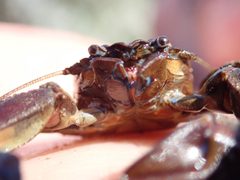
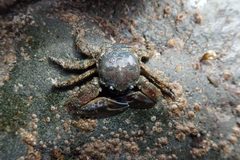
Distinguished from the similar Petrolisthes cinctipes by the broad carpi of the chelipeds, which have parallel sides and are twice as long as wide. The claws are usually similar in size and disproportionally large, being half again as long as the carpus. Body, limbs, and claws are flattened dorsally. Coloration is mainly reddish-brown or blueish-grey, with blue palps, some mouthparts, and blue knuckles on the cheliped dactyls. Limbs covered in conspicuous tufts of setae, most visible when submerged.
Images
Habitat
Found on rocky shores and subtidally to depths of 90 meters. Prefers areas with strong water currents. Occurs under rocks, particularly those embedded in sand or shingle, among seaweed, and in mussel beds. Present on both exposed and sheltered coasts.
Distribution
Eastern Pacific Ocean along the western coast of North America, from California to Alaska.
Diet
consuming primarily diatoms, gathered using setae on mouthparts. Also sweeps deposits from rock surfaces using tuft-bearing chelipeds for additional food intake.
Life Cycle
Females produce two annually. Larvae are free-living and planktonic, with zoeal stage characterized by a long rostrum. Limb occurs over several moults following .
Behavior
Forms small of males, females, and some juveniles. Engages in ritualized agonistic interactions with conspecifics, with larger individuals usually initiating encounters and retaining or gaining space. Displays graded escalation patterns including antennal taps and chela shoves. Simple approach can induce retreat in conspecifics.
Ecological Role
Contributes to benthic structure through deposit feeding and filter feeding activities. may influence local spatial distribution of individuals in rocky intertidal and subtidal .
Similar Taxa
- Petrolisthes cinctipesOverlapping distribution and general ; distinguished by cheliped carpus shape (P. eriomerus has parallel-sided carpi twice as long as wide, versus different proportions in P. cinctipes)