
Pleuroncodes planipes
Stimpson, 1860
pelagic red crab, tuna crab, squat lobster, langostilla, benthic anomuran red crab
Pleuroncodes planipes is a pelagic and benthic anomuran red crab distributed across the eastern Pacific Ocean, from California to Panama. The exhibits a complex with both pelagic and benthic phases: larvae and small individuals occupy open waters, while larger become exclusively benthic. It forms exceptionally dense on seamounts, with recorded densities up to 78 crabs/m² at depths of 355–385 m. The species tolerates hypoxic conditions (0.04 ml/l oxygen) and serves as a major prey item for large pelagic including yellowfin and skipjack tuna.
Pronunciation
How to pronounce Pleuroncodes planipes: /plɪəˈrɒŋkədiːz ˈplænɪˌpiːz/
These audio files are automatically generated. While they are not always 100% accurate, they are a good starting point.
Identification
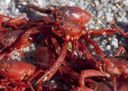
Small to medium-sized anomuran crab with a compressed, somewhat flattened body typical of squat lobsters. Standard length distinguishes life stages: individuals under ~2.6 cm carapace length are typically pelagic, while larger individuals are benthic. Coloration is generally red, consistent with . Distinguishable from other eastern Pacific galatheids by its distribution pattern and association with both pelagic and deep benthic . confirms conspecificity across the range from California to Panama.
Images
Habitat
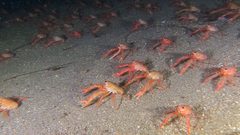
Deep benthic on seamounts and continental slopes; high- occur at 355–385 m water depth on seamount flanks, with lower densities at ~280 m. Associated with dense turbid layers 4–10 m above the bottom in hypoxic water (0.04 ml/l oxygen). Pelagic phase occurs in open waters of the California Current and offshore eastern Pacific, including waters over bathyal and abyssal depths (2,000–3,500 m).
Distribution
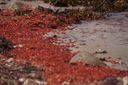
Eastern Pacific Ocean: California (San Diego, with mass stranding events recorded), western Baja California, Gulf of California, and extending south to Hannibal Bank seamount off Panama. The Panamanian represents a southern range extension confirmed by . Present in Rican waters. Pelagic larvae distributed throughout the California Current system, with breeding extending northward during warm years.
Seasonality
Breeding occurs during winter, primarily February and March. Larval presence in plankton peaks during these months. observed year-round in deep benthic , though may vary.
Diet
Phytoplankton captured by specialized filtration when in pelagic ; small zooplankton also consumed. Deposit feeding and scavenging when in benthic habitats.
Life Cycle
Complex with distinct pelagic and benthic phases. Larvae (zoeae and megalopas) and small individuals (<2.6 cm standard length) occupy pelagic waters. Late zoeae and megalopas carried offshore by geostrophic currents, with potential for in oceanic regions before return to coastal waters. Larger individuals occur exclusively in benthos. Large benthic reproduce in deep seamount ; pelagic ovigerous females and larvae have been observed over bathyal and abyssal depths (2,000–3,500 m), indicating pelagic may also reproduce.
Behavior
Forms high- and swarms with patchy distribution; density peaks in the middle of aggregations, resembling swarming insect patterns. Extremely abundant in historical pelagic patches spanning 7–16 km. Exhibits vertical patterns during larval stages. Tolerates hypoxic conditions in benthic aggregations.
Ecological Role
Major prey item for large pelagic , particularly yellowfin tuna and skipjack tuna off Baja California. Contributes significantly to seamount and biodiversity, forming part of ecological hotspots. Serves as a link between pelagic and higher .
Sources and further reading
- BugGuide
- GBIF taxonomy match
- NCBI Taxonomy
- Catalogue of Life
- crab spiders | Beetles In The Bush
- DISTRIBUTION OF THE LARVAE OF PLEURONCODES PLANIPES IN THE CALIFORNIA CURRENT
- Figure 5: Frequency distribution of quadrats with null and positive Pleuroncodes planipes counts.
- Figure 9: Pleuroncodes planipes abundance distribution in each of the three density peaks in Fig. 8.
- Behaviors of the pelagic red crab <i>Pleuroncodes planipes</i> (Decapoda: Anomura: Galatheidae) observed in captivity