
Pleuroncodes
Stimpson, 1860
red crab, tuna crab, squat lobster, múnida
Species Guides
1- Pleuroncodes planipes(pelagic red crab)
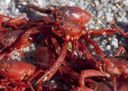
Pleuroncodes is a of anomuran crustaceans (squat lobsters) in the Munididae, found in the eastern Pacific Ocean. occupy both pelagic and benthic depending on life stage, with larvae and small individuals in pelagic waters and larger on the seafloor. The genus includes commercially and ecologically important species that form dense and serve as prey for large marine .
Pronunciation
How to pronounce Pleuroncodes: //plʊˈɹɒŋkoʊdiːz//
These audio files are automatically generated. While they are not always 100% accurate, they are a good starting point.
Images
Habitat
Benthic on seamounts, continental shelf, and continental slope; depths ranging from ~280 m to 385 m for high- . Associated with hypoxic conditions (oxygen levels as low as 0.04 ml/l) and dense turbid layers 4–10 m above the bottom. Pelagic waters for larval and small stages.
Distribution
Eastern Pacific Ocean: California Current system (including southern California Bight), western Baja California, and coastal eastern tropical Pacific (Hannibal Bank seamount off Panama). Range extends from temperate to tropical waters.
Diet
Pelagic stages: phytoplankton via specialized filtration feeding, plus small zooplankton. Benthic stages: deposit feeding and scavenging.
Life Cycle
Larvae and small individuals (<2.6 cm length) are pelagic; larger individuals transition to exclusively benthic existence. Breeding occurs in winter (primarily February–March in California Current). Pelagic ovigerous females and larvae have been observed over bathyal and abyssal depths (~2,000–3,500 m), indicating pelagic can occur. Late zoeae and megalopae are carried offshore by geostrophic currents.
Behavior
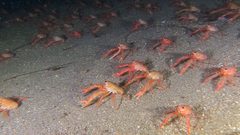
Forms high- benthic or swarms (up to 78 individuals/m²) with patchy distribution; density peaks in patch centers resembling insect swarm structure. Exhibits diel vertical in larval stages: near surface at night, deeper during day. Large pelagic patches historically reported spanning 7–10 km.
Ecological Role
Major prey item for large pelagic including yellowfin tuna and skipjack tuna. Contributes significantly to seamount and ecological hotspot dynamics. Spatial overlap with forage fish such as Peruvian anchovy in pelagic .
Human Relevance
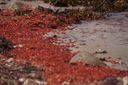
Supports commercial fisheries and serves as for productivity. Mass strandings on beaches (e.g., San Diego 2015) attract public attention. Subject of acoustic survey methods for estimation in marine protected areas.
Sources and further reading
- BugGuide
- GBIF taxonomy match
- NCBI Taxonomy
- Catalogue of Life
- DISTRIBUTION OF THE LARVAE OF PLEURONCODES PLANIPES IN THE CALIFORNIA CURRENT
- Figure 5: Frequency distribution of quadrats with null and positive Pleuroncodes planipes counts.
- Figure 9: Pleuroncodes planipes abundance distribution in each of the three density peaks in Fig. 8.
- Breeding behavior and sex ratio variation of Pleuroncodes monodon (Crustacea: Galatheidae) off the Peruvian coast
- Distribución y biomasa de anchoveta (Engraulis ringens) y múnida (Pleuroncodes monodon) en el ecosistema marino de la Reserva Nacional de Paracas, región sur del Perú