
Sida crystallina
(O. F. Müller, 1776)
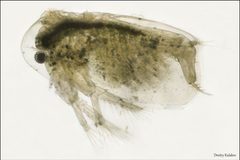
Sida crystallina is a freshwater cladoceran (ctenopod) in the Sididae. It is an epiphytic strongly associated with aquatic macrophytes, attaching to plant stems using adhesive secretions from the nuchal organ. The exhibits functional separation between locomotory and feeding appendages, with frequent swimming observed especially in juveniles. It has been documented across Europe and Asia, including detailed studies in South Korea and North America.
Pronunciation
How to pronounce Sida crystallina: //ˈsiː.də ˌkrɪs.təˈlaɪ.nə//
These audio files are automatically generated. While they are not always 100% accurate, they are a good starting point.
Identification
Distinguished from other epiphytic cladocerans by stronger attachment to macrophyte stems via nuchal organ secretions. Typically found attached to emergent plant stems rather than free-swimming. Six pairs of serially similar trunk limbs represent plesiomorphic cladoceran traits. Body length correlates with filtering rate, with larger individuals showing higher rates.
Images
Habitat
Lentic freshwater with abundant aquatic macrophytes. Strongly associated with emergent plant stems, particularly in . Documented on Phragmites australis and Paspalum distichum in South Korean studies; also recorded on Nymphaea odorata in North American .
Distribution
Europe; South Korea (147 lentic freshwater bodies surveyed); North America (Michigan, USA). GBIF records indicate presence in Palearctic and Oriental (Indomalaya) regions.
Diet
consuming suspended particles <35 µm and epiphytic organic matter (EOM) on macrophytes. Stable isotope analysis confirms epiphytic organic matter as food source. Filtering rate decreases with increasing food concentration.
Host Associations
- Phragmites australis - attachment substrateemergent stem surfaces used for attachment
- Paspalum distichum - attachment substrateemergent stem surfaces used for attachment
- Nymphaea odorata - attachment substrateleaf surfaces used for sampling in Michigan studies
Behavior
Attaches to macrophyte surfaces using adhesive substances secreted by the nuchal organ; attachment strength exceeds that of other epiphytic cladocerans. Swims frequently and well when disturbed, with juveniles moving between substrates more often than and occupying positions nearer the water surface. Reattachment sites located visually. movement patterns show limited variation compared to some littoral .
Ecological Role
Epiphytic consumer of organic matter on macrophytes; contributes to high diversity and abundance of epiphytic in complex macrophyte structures. Filter feeding activity processes suspended particulate matter in . influenced by food availability and fish .
Similar Taxa
- SimocephalusAlso a filter-feeding cladoceran attached to plants, but Sida crystallina shows stronger attachment strength and more frequent swimming when disturbed
- Chydorid CladoceraShare epiphytic but differ in feeding mode—chydorids are periphyton and detritus feeders correlated with diatom , whereas Sida is a not correlated with diatom density
More Details
Subspecies
Two recognized: Sida crystallina crystallina (O. F. Müller, 1776) and Sida crystallina americana Korovchinsky, 1979
Filtering rate equation
In situ filtering rate (VF, ml·animal⁻¹·d⁻¹) predictable from body length (L, mm) and concentration of small (<35 µm) suspended particles (Sn, mg·liter⁻¹ dry wt)
Sources and further reading
- BugGuide
- Wikipedia
- GBIF taxonomy match
- iNaturalist taxon
- NCBI Taxonomy
- Catalogue of Life
- The Sith Lord of the Sea: Supergiant Isopod in the WoRMS’ Top 10 Marine Species of 2025 | Blog
- New giant sea bug species named after Darth Vader
- Movement and Microdistribution of Sida Crystallina and Other Littoral Microcrustacea
- Effects of 17α-ethinylestradiol on the reproduction of the cladoceran species Ceriodaphnia reticulata and Sida crystallina
- Distribution and attachment characteristics of Sida crystallina (O.F. Müller, 1776) in lentic freshwater ecosystems of South Korea
- Birth and Death Rates of a Littoral Filter Feeding Microcrustacean, Sida crystallina (Cladocera), in Cochran Lake, Michigan
- The effect of body size and food concentration on the in situ filtering rate of Sida crystallina1
- Transitions in functional morphology from “large branchiopods” to Cladocera: Video and confocal microscopic studies of Cyclestheria hislopi (Cyclestherida) and Sida crystallina (Cladocera: Ctenopoda)