
Pycnogonum stearnsi
Ives, 1883
Stearns' sea spider
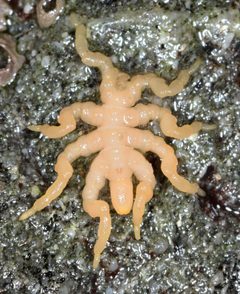
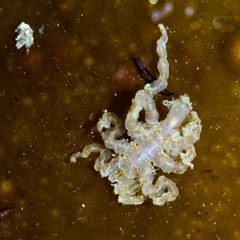
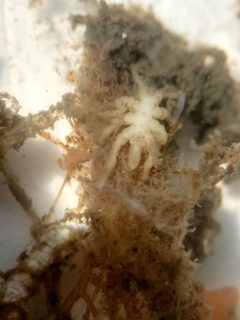
Pycnogonum stearnsi is a sea spider in the Pycnogonidae, found on the Pacific coast of North America and in Japan. It reaches about 2.5 cm in length and lacks , , and —unusual traits among sea spiders. It feeds by inserting its barrel-shaped into soft-bodied prey and sucking fluids. Males carry masses on specialized ovigerous legs.
Pronunciation
How to pronounce Pycnogonum stearnsi: /pɪkˈnɒɡənəm ˈstɜrnzaɪ/
These audio files are automatically generated. While they are not always 100% accurate, they are a good starting point.
Identification
Distinguished from other sea spiders by the complete absence of , , and . The barrel-shaped and plain white to cream coloration are additional diagnostic features. Males can be identified by the presence of ovigerous legs, which females lack. Among Pycnogonum , the specific combination of eyelessness, proboscis shape, and northeastern Pacific distribution helps confirm identification.
Images
Habitat
Intertidal zone from mid shore to low water mark. Shelters under rocks or inside dead barnacle shells. Frequently found in close association with its prey organisms.
Distribution
Northeast Pacific Ocean from British Columbia, Canada south to California, USA; also recorded from Japan. Most abundant in California.
Diet
Fluid-feeding of soft-bodied marine . Prey includes sea anemones (Anthopleura sola, Anthopleura xanthogrammica, Anthopleura elegantissima, Metridium senile), hydroids (Obelia, Aglaophenia), and sea squirts (Clavelina). Feeds by thrusting into prey and sucking fluids, leaving prey flaccid but alive.
Host Associations
- Anthopleura sola - preysea anemone
- Anthopleura xanthogrammica - preysea anemone
- Anthopleura elegantissima - preysea anemone
- Metridium senile - preysea anemone
- Obelia - preyhydroid
- Aglaophenia - preyhydroid
- Clavelina - preysea squirt
Life Cycle
Gonochoristic (separate sexes). released from female on legs and fertilized externally by male. Male collects eggs and presses them onto ovigerous legs, forming a large white adhering mass that he carries. Eggs hatch into swimming larvae, which undergo multiple through nymphal stages before developing and feeding .
Behavior
Hides under rocks and in dead barnacle shells during non-feeding periods. Males actively collect and transport masses. Larvae are free-swimming prior to settlement.
Ecological Role
of marine in intertidal . -like feeding strategy removes prey fluids without immediate death. Serves as prey for larger intertidal predators (specific predators not documented).
Human Relevance
No documented economic importance. Occasionally encountered by tidepool observers and marine biologists studying intertidal . Not harmful to humans.
Similar Taxa
- Other PycnogonidaeMost sea spiders possess and , which P. stearnsi lacks
- Other Pycnogonum speciesMany have or spiny body processes; P. stearnsi is eyeless and lacks spines
More Details
Taxonomic note
The was described by Ives in 1883. The Pycnogonum is characterized by reduced appendages compared to other sea spider genera.
Feeding mechanism
Unlike most sea spiders that use to manipulate food, P. stearnsi relies entirely on its for prey capture and feeding.