
Superstitionia
Stahnke, 1940
Species Guides
1- Superstitionia donensis(Superstition Mountains Scorpion)
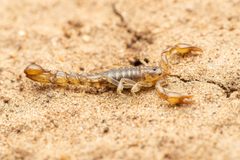
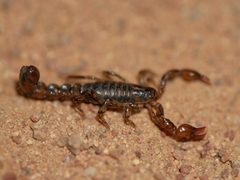
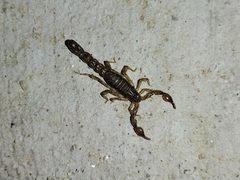
Superstitionia is a of scorpions containing the single S. donensis. It is the only genus in the Superstitioniidae. Unlike other members of its family, which are cave-adapted and lack pigmentation and lateral , S. donensis is darkly pigmented and possesses lateral eyes. The genus was established in 1940 based on specimens from the Superstition Mountains of Arizona.
Pronunciation
How to pronounce Superstitionia: //ˌsuːpərˌstɪʃiˈoʊniə//
These audio files are automatically generated. While they are not always 100% accurate, they are a good starting point.
Identification
The sole S. donensis can be distinguished from other Superstitioniidae by its dark tan to brown coloration, shiny spotted , and presence of lateral . Other members are unpigmented and lack lateral eyes due to cave . reach approximately 30 mm in length. A noted deformity in finger has been observed in at least one specimen, which may complicate identification if more widespread.
Images
Habitat
Found in mountain terrain and under rocks or near plants in desert environments. Unlike other Superstitioniidae, which are exclusively cave-dwelling, this inhabits surface .
Distribution
Southwestern United States and northwestern Mexico. In the U.S., recorded from western New Mexico, Arizona, extreme southern Nevada, and southern California. In Mexico, recorded from Baja California, Baja California Sur, and Sonora.
Human Relevance
Venom studies indicate transcriptional profiles distinct from better-known , though not more venomous than other scorpions. Venom composition remains understudied.
Similar Taxa
- Other Superstitioniidae (cave-dwelling genera)Superstitionia differs in possessing pigmentation and lateral , and in inhabiting surface rather than cave environments.
More Details
Taxonomic uniqueness
Superstitionia donensis is the only surface-dwelling, pigmented, eyed member of an otherwise cave-adapted , representing a significant ecological and morphological outlier within Superstitioniidae.
Research status
Venom molecular studies indicate this is poorly researched relative to other , with distinct toxin profiles that warrant further investigation.