
Microbisium parvulum
(Banks, 1895)
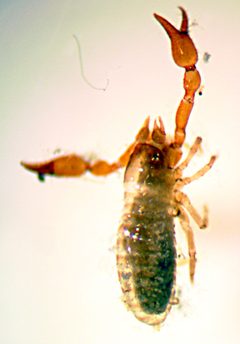
Microbisium parvulum is a of pseudoscorpion first described by Banks in 1895. It belongs to the Neobisiidae, a group of small arachnids commonly found in soil and leaf litter . The species has been recorded in North America and Middle America. Like other pseudoscorpions, it possesses pincer-like but lacks a tail and stinger.
Pronunciation
How to pronounce Microbisium parvulum: /maɪˌkroʊˈbɪziəm ˈpɑrvjʊləm/
These audio files are automatically generated. While they are not always 100% accurate, they are a good starting point.
Identification
Distinguished from true scorpions by the absence of a metasoma (tail) and (stinger). Within Neobisiidae, precise identification to level requires examination of trichobothrial patterns on the and other microscopic characters. Differentiation from other Microbisium species depends on detailed morphological analysis not readily available in general sources.
Images
Appearance
Small pseudoscorpion with pincer-shaped . Body divided into prosoma and opisthosoma. Lacks the elongated tail and stinger characteristic of true scorpions. Specific size and coloration details for this are not well documented in available sources.
Habitat
Found in soil and leaf litter microhabitats. Specific substrate preferences for this are not documented.
Distribution
Recorded from North America and Middle America. Distribution records indicate presence in both regions, though specific country-level localities are not detailed in available sources.
Life Cycle
Pseudoscorpions generally develop through , , deutonymph, tritonymph, and stages. Specific details for M. parvulum are not documented.
Similar Taxa
- True scorpions (order Scorpiones)Superficially similar due to pincer-like appendages, but distinguished by the presence of a segmented tail with terminal stinger in scorpions, which pseudoscorpions lack.
More Details
Taxonomic note
The Microbisium is part of the Neobisiinae within the Neobisiidae. The specific epithet 'parvulum' is Latin for 'very small,' suggesting diminutive size relative to .