
Neobisiidae
Chamberlin, 1930
neobisiid pseudoscorpions
Genus Guides
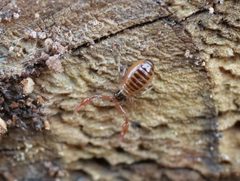
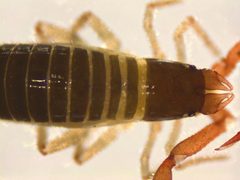
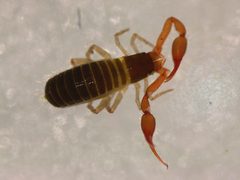
3Neobisiidae is a of pseudoscorpions comprising approximately 550-750 across 32-34 , distributed across Africa, the Americas, and Eurasia. Members are small arachnids ranging from 1 to 5 mm in body length, with body colors varying from reddish or dark brown through olive green to yellow or creamy white. The family includes both surface-dwelling and cave-dwelling species, with troglobitic species often exhibiting reduction or loss. Several genera, notably Stenohya, exhibit pronounced in .
Pronunciation
How to pronounce Neobisiidae: /ˌniːoʊˈbɪzi.aɪdiː/
These audio files are automatically generated. While they are not always 100% accurate, they are a good starting point.
Identification
Distinguished from other pseudoscorpion by the location of the venom gland and duct in the immobile rather than movable finger of the . The elongated pedipalps with prominent chelae resemble true pincers. Cave-dwelling may be identified by reduced or absent . -level identification requires examination of pedipalp and leg ; Stenohya males exhibit distinctive with thorns or on pedipalpal , patella, and chela absent in females.
Images
Habitat
Surface-dwelling occur in leaf litter and under rocks. Some species are troglobitic, inhabiting caves. One species (Stenohya pengae) has been recorded from the layer.
Distribution
Africa, the Americas, and Eurasia. Specific records include China (Guangxi, Fujian, Yunnan, Chongqing), Serbia, and Scandinavia (Denmark, Norway, Sweden).
Behavior
Venom from immobile finger used to capture and immobilize prey.
Sources and further reading
- BugGuide
- Wikipedia
- GBIF taxonomy match
- iNaturalist taxon
- NCBI Taxonomy
- Catalogue of Life
- Review of the pseudoscorpion genus Stenohya Beier, 1967 from China (Pseudoscorpiones, Neobisiidae)
- New and little-known pseudoscorpions of the genus Roncus L. Koch (Neobisiidae, Pseudoscorpiones) from Serbia, Yugoslavia
- Description of two Stenohya species from China (Pseudoscorpiones, Neobisiidae), with comments on the exaggerated sexual dimorphic pedipalp in this genus
- Prediction of Suitable Habitats for Bisetocreagris (Pseudoscorpiones: Neobisiidae) in China and Its Application in Conserving Endemic Species Diversity.
- Three new Stenohya species with sexually dimorphic leg I from China (Pseudoscorpiones, Neobisiidae).