
Speleonychia sengeri
Briggs, 1974
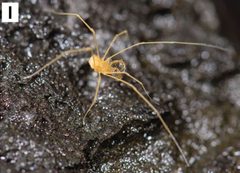
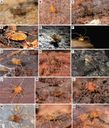
Speleonychia sengeri is a troglobitic harvestman (order Opiliones) described by Briggs in 1974. The Speleonychia is to cave systems in western North America. As a member of the Cladonychiidae, this belongs to a group of small, eyeless, pale-colored arachnids adapted to subterranean environments. Very few observations exist—only five records on iNaturalist—reflecting its restricted and cryptic lifestyle.
Pronunciation
How to pronounce Speleonychia sengeri: /ˌspɛliːoʊˈnɪkiə ˈsɛnɡəri/
These audio files are automatically generated. While they are not always 100% accurate, they are a good starting point.
Images
Habitat
Strictly cave-dwelling (troglobitic). Inhabits subterranean limestone or karst systems with stable temperature and high humidity. Requires complete darkness and moist microhabitats.
Distribution
North America; known from cave systems in the western United States. Specific localities are limited and likely restricted to isolated karst regions.
More Details
Conservation status
As a narrow-range troglobite with highly restricted distribution, this is likely vulnerable to groundwater pollution, disturbance, and climate change affecting cave microclimates. No formal IUCN assessment is available.
Taxonomic notes
The Speleonychia was established for cave-adapted harvestmen previously confused with surface-dwelling relatives. The specific epithet honors an individual (Senger) associated with the type locality or collection.