
Cosmetidae
Koch, 1839
Pied Harvestmen
Genus Guides
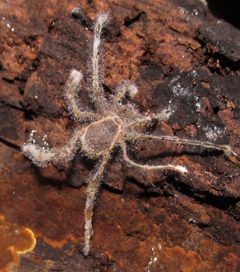
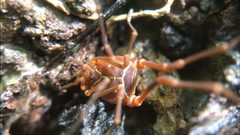
4Cosmetidae is one of the largest of harvestmen (Opiliones), comprising over 700 across 125+ . The family is to the New World with a Nearctic-Neotropical distribution, reaching its greatest diversity in Mexico, Central America, and northern South America, particularly the Andean regions. The northern range extends into the southern United States. The family name derives from the Greek 'kosmetós' meaning ',' referring to the elaborate white, yellow, or occasionally green, orange, or red markings on the body. The family has undergone substantial taxonomic revision, with seven currently recognized following phylogenetic analyses.

Pronunciation
How to pronounce Cosmetidae: /kɔsˈmɛtɪdiː/
These audio files are automatically generated. While they are not always 100% accurate, they are a good starting point.
Identification
Distinguished from other Laniatores by the combination of: very low, saddle-shaped mound on middle of ; slit-like ozopores with partial coverage by coxal ; weakly armed and tergites; and the characteristic compressed applied to . The elaborate color patterns are often diagnostic at the level. The conservative with rectangular plate and thumb-like dorsal process separates Cosmetidae from its sister group Gonyleptidae and related families Stygnidae and Cranaidae.
Images
Habitat
Primarily tropical and subtropical forests including primary rainforest, tropical montane cloud forest, and Atlantic Forest. Occurs in diverse microhabitats: tree-fall gaps, inner forest, forest edge, and log piles. Some associated with stream environments in the Humid Chaco. Distribution modeling suggests occurrence is determined by absence of a dry season and presence of a hot summer rather than temperature alone.
Distribution
Strictly New World with Nearctic-Neotropical distribution. Northern extent reaches southern United States (southern states only). Center of diversity in Mexico, Central America, and northern South America, especially Andean realms. Range extends south to Argentina and southern Brazil; absent from Chile. Prevalent in Amazonian region with fewer in Brazilian Atlantic Forest. Present in Caribbean. Southernmost records from Argentina represent the southern limit of the .
Similar Taxa
- GonyleptidaeSister group to Cosmetidae; distinguished by different genital and typically more heavily armed body.
- StygnidaeClosely related ; differs in body armature and genital structure.
- CranaidaeClosely related ; separated by morphological features of the and body armature.
More Details
Taxonomic History
The was long divided into two (Cosmetinae and Discosomaticinae) but was subsequently reorganized into seven subfamilies based on phylogenetic analysis: Cosmetinae, Cynortinae, Discosomaticinae, Ferkeriinae, Flirteinae, Libitiinae, Metergininae, and Taitoinae. Many currently recognized remain unplaced in subfamilies due to poorly resolved basic .
Phylogenetic Relationships
Cosmetidae is the sister-group of Gonyleptidae; both are closely related to Stygnidae and Cranaidae. Recent phylogenetic analyses have revalidated several previously synonymized, including Libitioides from Vonones.
Etymology
name derived from the type Cosmetus, from the Greek kosmetós meaning ',' referring to the decorative color patterns characteristic of many .
Sources and further reading
- BugGuide
- Wikipedia
- GBIF taxonomy match
- iNaturalist taxon
- NCBI Taxonomy
- Catalogue of Life
- Arachnida | Beetles In The Bush | Page 6
- Bibliography | Beetles In The Bush
- New records and distribution modeling of Gryne orensis (Sørensen) (Opiliones: Cosmetidae) support the Mesopotamian-Yungas disjunction in subtropical Argentina
- Taito adrik, a new harvestman species from the Área de Conservación Privada Panguana, Peruvian Amazonia (Opiliones: Laniatores: Cosmetidae)
- Description of a new species of Eucynorta (Opiliones, Cosmetidae) from Cortés, Honduras
- Taxonomic revision of the Andean harvestman genus Rhaucus Simon, 1879 (Arachnida, Opiliones, Cosmetidae)
- The short-legged Andean cosmetids revisited: the genus Libitia Simon, 1879 with description of two new species (Opiliones, Cosmetidae)
- Once upon a time in America: recognition of the species of Libitioides from USA, with comments on other American Cosmetidae (Opiliones, Laniatores)
- A fresh look at Cosmetus Perty, 1833 (Opiliones: Cosmetidae), with new synonymies and description of two new species from Colombia
- Giving attention to the oldies: redescription of Meterginus basalis (Arachnida: Opiliones: Cosmetidae) with some notes on the genitalia
- Distribution extension of Flirtea picta Perty, 1832 (Opiliones: Cosmetidae) to Brazilian Atlantic Forest with notes on ecology