
Erginulus
Roewer, 1912
Species Guides
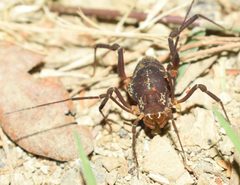
1Erginulus is a of harvestmen in the Cosmetidae, described by Roewer in 1912 with the type Erginus serratipes. The genus comprises 29 described species distributed primarily in eastern Mexico and northern Central America, with a few outlying records. Species are medium to large-sized cosmetid harvestmen, with Erginulus clavotibialis in Belize reaching 6–7.5 mm body length. Males exhibit with two distinct (α and β males), characterized by enlarged and armed leg IV with or spines; females have smaller chelicerae and unarmed legs.
Pronunciation
How to pronounce Erginulus: /ɛrˈɡɪnjʊləs/
These audio files are automatically generated. While they are not always 100% accurate, they are a good starting point.
Images
Habitat
Forested , typically found beneath logs and rocks. Erginulus clavotibialis has been documented in forested areas adjacent to hiking trails in Belize.
Distribution
Eastern Mexico (including Yucatán Peninsula, Veracruz, Chiapas, Campeche, Durango, Tamaulipas), Guatemala, Belize, Honduras, El Salvador, Rica, Colombia, Cuba, and Bahamas. Core distribution centers on eastern Mexico and northern Central America, with peripheral records in Caribbean islands and northern South America.
Host Associations
Life Cycle
nymphs and have been observed; earlier nymphal instars or larvae have not been documented in field studies.
Behavior
(leg threading) observed, where and are brought to mouth and passed laterally between bases of palpi and leg I. Performed when active, often after feeding, for several minutes at a time. This behavior may explain the absence of mites from leg segments.
Ecological Role
More Details
Taxonomic history
Originally described as Erginus serratipes by Roewer in 1912, later transferred to Erginulus. The was subsequently placed in Metergininae.
Sexual dimorphism
Males occur in two distinct (α and β males), both with larger and armed patella-tibia IV; females are slightly larger with smaller chelicerae and unarmed leg IV.