
Trachyrhinus favosus
(Wood, 1868)
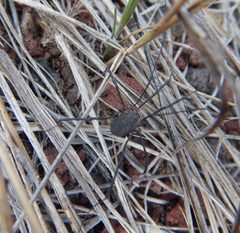
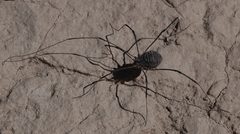
Trachyrhinus favosus is a harvestman (order Opiliones) in the Sclerosomatidae. The is characterized by a predominantly black body with yellow-brown femoral bases and orange intersegmental articular at leg bases. It exhibits a distinctive defensive of vigorous vertical bouncing that blurs body form while allowing continued locomotion. The species has a narrow geographic range in the central Great Plains of North America and is active only during autumn.
Pronunciation
How to pronounce Trachyrhinus favosus: /ˌtrækɪˈraɪnəs ˈfævoʊsəs/
These audio files are automatically generated. While they are not always 100% accurate, they are a good starting point.
Identification
Distinguished from similar harvestmen by combination of: relatively short legs (not extremely elongated); nearly black body with contrasting yellow-brown to orange coloration at leg bases; orange intersegmental articular . The bouncing defensive , if observed, may aid identification. Within the Trachyrhinus, specific identification requires examination of male genitalia or reference to Cokendolpher (1981).
Images
Habitat
Shortgrass prairie; found in open grassland environments.
Distribution
Narrow band from North Dakota south to north-central Texas; known from western Nebraska.
Seasonality
Active only during fall (autumn).
Behavior
When disturbed, performs vigorous vertical bouncing that functions to blur body form as a defensive mechanism. The bouncing continues even while the animal walks away calmly. Does not produce silk or venom; relies on chemical defenses from repugnatorial glands and the bouncing for protection.
Similar Taxa
- Other Sclerosomatidae harvestmenMany have much longer legs, especially the second pair, and lack the distinctive orange articular and black body coloration of T. favosus.
- Other Trachyrhinus speciesRequire examination of male genitalia or reference to Cokendolpher (1981) revision for reliable differentiation; T. favosus distinguished by specific coloration and geographic range.
More Details
Chemical defenses
Like other harvestmen, possesses repugnatorial glands that produce defensive compounds including phenols, quinones, ketones, and/or alcohols. The aposematic coloration (warning coloration) likely advertises these distasteful or noxious chemical defenses to potential .
Taxonomic history
Originally described by Wood in 1868. placement confirmed as Sclerosomatidae by expert Marshal Hedin. Revised by Cokendolpher (1981) in Journal of Arachnology.