
Aphonopelma iodius
(Chamberlin & Ivie, 1939)
Desert Tarantula, Great Basin Blonde, Fresno County Blonde, Salt Lake City Brown, Northern Blonde
Aphonopelma iodius is a medium-sized tarantula native to the southwestern United States, inhabiting desert regions of California, Nevada, Arizona, and Utah. The has undergone significant taxonomic revision, with former species A. angusi, A. melanium, A. nevadanum, and A. smithii synonymized under it based on morphological and molecular analyses. Males reach sexual maturity at approximately seven years and emerge from burrows in autumn to seek mates. Females are long-lived, with documented lifespans exceeding thirty years in captivity.
Pronunciation
How to pronounce Aphonopelma iodius: //æ.fəˈnɒ.pɛl.mə ˈaɪ.oʊ.di.əs//
These audio files are automatically generated. While they are not always 100% accurate, they are a good starting point.
Identification
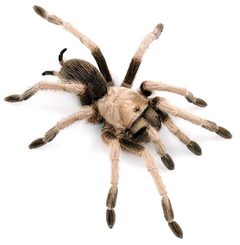
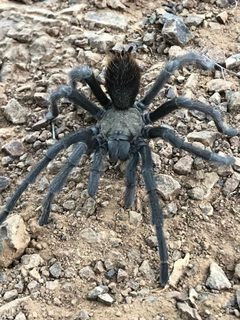
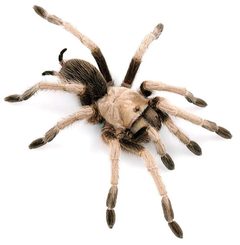
Aphonopelma iodius is challenging to distinguish from other Aphonopelma based on external alone, as the exhibits limited diagnostic anatomical features. The species is generally smaller than A. chalcodes (Arizona Blonde), with less pronounced color contrast between leg segments. Mature males can be recognized by the presence of tibial spurs on the front legs, used during mating to restrain female fangs. Accurate identification typically requires examination of genitalia or molecular analysis.
Images
Habitat
Occupies webbed burrows in desert areas, particularly the Mojave Desert west of the Colorado River. Burrows are constructed beneath the soil surface and are commonly sealed with a silken or silk-and-dirt plug to regulate temperature and deter . During winter, burrows are plugged with soil to maintain stable conditions.
Distribution
United States: California, Nevada, Arizona, and Utah. Most common in the Mojave Desert region west of the Colorado River.
Seasonality
males are active above ground during autumn mating season. Females remain in burrows year-round, with nighttime hunting activity at burrow entrances during warmer months. Winter months are spent in sealed burrows.
Life Cycle
Sexual maturity is reached at approximately seven years in males. Mating occurs in autumn, with males dying by mid-autumn after breeding. Females store sperm in spermathecae and lay the following spring or summer. The continues molting after reaching adulthood, a trait uncommon among spiders.
Behavior
Constructs and maintains silk-lined burrows with defensive plugging . Males exhibit ground-tapping and vibrational signaling when approaching female burrows to elicit for mating. When threatened, individuals may use for defense by kicking them from the rather than biting. These barbed hairs cause irritation to mucous and can trigger allergic reactions in sensitive individuals.
Human Relevance
Occasionally kept in captivity, where females have been documented living over thirty years. Available in the pet trade under various regional , though less frequently encountered than more colorful tarantula . Not considered dangerous to humans; bites are rare and venom is not medically significant.
Similar Taxa
- Aphonopelma chalcodesLarger body size and more pronounced in coloration; females have black with remaining leg segments brown, whereas A. iodius shows less contrast
- Aphonopelma johnnycashiMature males are solid black and larger (up to 6 inches leg span), with geographic restriction to California near Folsom Prison area
- Aphonopelma joshuaGeographically and phenotypically distinct recognized in the same 1997 revision that synonymized species under A. iodius
- Aphonopelma mojaveGeographically and phenotypically distinct recognized in the same 1997 revision that synonymized species under A. iodius
More Details
Taxonomic History
A 1997 study by Prentice synonymized A. angusi, A. melanium, and A. nevadanum with A. iodius, using the epithet 'iodium' (later corrected to 'iodius' as the proper neuter comparative adjective form). A 2016 integrative taxonomic study by Hamilton, Hendrixson, and Bond added A. smithii (Bay Area Blonde Tarantula) to this synonymy based on failure of morphological and molecular analyses to distinguish it from A. iodius. The World Spider Catalog accepted this synonymy as of January 2021.
Pet Trade Nomenclature
The is marketed under numerous regional names including Great Basin Blonde, Fresno County Blonde, Desert Tarantula, Salt Lake City Brown, and Northern Blonde, reflecting its broad distribution and phenotypic variation across that range.
Sources and further reading
- BugGuide
- Wikipedia
- GBIF taxonomy match
- iNaturalist taxon
- NCBI Taxonomy
- Catalogue of Life
- An Arachnid Kind of Day | Bug Squad
- Tarantulas to Grab the Spotlight at UC Davis Seminar on April 21 | Bug Squad
- Will climate change be a threat for a new tarantula species?
- New tarantula named after Johnny Cash among 14 spider species found in the United States | Blog
- Bug Eric: Spider Sunday: Arizona Blonde Tarantula