
Calisoga longitarsis
(Simon, 1891)
False Tarantula
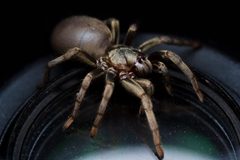
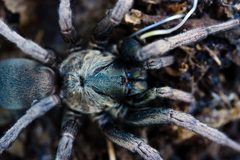
Calisoga longitarsis is a mygalomorph spider in the Nemesiidae, commonly known as the False Tarantula. It is one of several in the Calisoga distributed around the Central Valley of California. The species has been studied as part of research on ring speciation dynamics in California mygalomorph spiders. It is frequently observed and photographed, with over 2,300 records on iNaturalist.
Pronunciation
How to pronounce Calisoga longitarsis: //kəˈlaɪsəɡə/ /ˌlɒn.dʒɪˈtɑːr.sɪs//
These audio files are automatically generated. While they are not always 100% accurate, they are a good starting point.
Identification
Calisoga longitarsis can be distinguished from true tarantulas ( Theraphosidae) by its membership in Nemesiidae, a separate family of mygalomorph spiders. Within the Calisoga, precise identification to level requires examination of morphological details and potentially genetic analysis, as the genus forms a lineage-rich complex with ongoing taxonomic study. The "False Tarantula" reflects its superficial resemblance to larger tarantulas while being taxonomically distinct.
Images
Distribution
United States, specifically California. The Calisoga is distributed around the Central Valley of California.
Similar Taxa
- True tarantulas (Theraphosidae)Superficially similar in appearance and body plan, both being large-bodied mygalomorph spiders, but distinguished by -level and morphological details
- Other Calisoga speciesOther members of the Calisoga occur in the same geographic region and form a closely related complex; boundaries within the genus are subject to ongoing phylogenomic research
More Details
Ring speciation research
Calisoga longitarsis and other members of the have been studied as a potential example of ring speciation, where expand around a geographic barrier (the Central Valley of California) with terminal forms that may coexist without interbreeding. Research using ultraconserved elements (UCEs) and mitogenomes has tested predictions about timing, ancestry, connectivity, and terminal overlap in this system.
Taxonomic history
Originally described as Brachythele longitarsis by Simon in 1891, the was later transferred to the Calisoga. The genus has been subject to modern phylogenomic revision to clarify species boundaries and evolutionary relationships.