
Nemesiidae
Simon, 1889
Tubetrapdoor and Wishbone Spiders, wishbone spiders
Genus Guides
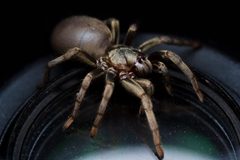
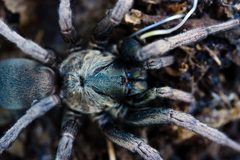
1Nemesiidae is a of mygalomorph spiders first described by Eugène Simon in 1889 and elevated to family status in 1985, having previously been considered part of Dipluridae. The family comprises relatively large, darkly colored spiders with elongated bodies and robust legs, commonly known as wishbone spiders due to the distinctive shape of their burrows. Members are primarily , constructing silk-lined burrows often equipped with hinged trapdoors for ambush . The family includes ten and approximately 195 distributed across diverse including coastal sands, forests, and mountainous regions on multiple continents.
Pronunciation
How to pronounce Nemesiidae: //nɛˈmɛzi.aɪ.diː//
These audio files are automatically generated. While they are not always 100% accurate, they are a good starting point.
Identification
Nemesiidae can be distinguished from other mygalomorph by the combination of: three-segmented lateral with a short domed segment; absence of a third claw; divided scopulae on III–IV; and specific male genitalic features including palpal bulb with keels near the embolus base resting in a deep tibial excavation. Females of some possess sclerotized supraspermathecal chambers. The family differs from Dipluridae (to which it was formerly assigned) in these spinneret and claw characteristics. Within Nemesiidae, genera are distinguished by details of embolus , spermathecal structure, and leg scopulation patterns.
Images
Habitat
Primarily , inhabiting self-constructed burrows in diverse substrates. Documented include: sandy soils of oceanic and river coastal areas with psammophyte vegetation (Chaco spp. in Uruguay); oak forests in mountainous regions (Raveniola niedermeyeri in Iran's Alborz Mountains); Atlantic Forest (Mata Atlântica) in Brazil (Psalistopoides); and various forest and grassland environments across Central Asia, Western Asia, and the Neotropics. Some show high habitat specificity, such as dependence on old hollow myrtle beech trees in humid forests.
Distribution
Widespread across multiple continents including: South America (Brazil, Uruguay, Argentina), Central Asia (Kazakhstan, Kyrgyzstan, Tajikistan, Uzbekistan, Turkmenistan, Afghanistan), Western Asia (Iran, Turkey, Armenia, Azerbaijan, Georgia, Russia), East Asia (China), Europe (Italy), and Australia. The exhibits significant diversity in the Neotropical region and across Eurasia, with many showing restricted, locally distributions.
Seasonality
activity observed in natural conditions for some (e.g., Chaco spp.). Specific seasonal patterns not well documented across the due to limited field observations and the difficulty of collecting these secretive, burrow-dwelling spiders.
Life Cycle
Developmental stages include , spiderling, and . Females of some guard eggs in burrows. Detailed information is sparse due to the difficulty of observing these spiders in their sealed burrows.
Behavior
Strictly , spending the majority of their lives in silk-lined burrows. Burrows are typically constructed with a flap-like or hinged trapdoor that the spider pushes up with its front legs to ambush passing prey. The door provides cover for the ambush and is quickly closed after prey capture. Spiders rarely leave their burrows except for mating, when both sexes emerge briefly before returning to their respective burrows. Some burrows have side tubes. Hunting involves lifting the burrow entrance, seizing prey, and rapid withdrawal. Activity is primarily .
Ecological Role
in soil and litter ; specific ecological impacts not well studied. Burrowing activity may contribute to soil aeration and nutrient cycling in some .
Human Relevance
Vulnerable to destruction, particularly where psammophyte vegetation or old-growth forests are degraded. Some (e.g., Chaco spp. in Uruguay) are of conservation concern due to declining coastal sand dune habitats. No documented medical or economic importance.
Similar Taxa
- DipluridaeNemesiidae was formerly classified within Dipluridae; distinguished by three-segmented lateral with short domed segment, absence of third claw, and specific genitalic
- HexurellidaeAnother of small mygalomorph spiders; Nemesiidae differs in burrow construction with trapdoors and specific segmentation
- IdiopidaeAlso contains trapdoor spiders; distinguished by different burrow architecture and male genitalic features
More Details
Taxonomic History
Elevated from status within Dipluridae to rank in 1985 based on morphological distinctiveness. The family has undergone significant revision, with such as Pycnothele, Raveniola, and Psalistopoides receiving detailed taxonomic treatment.
Conservation Concerns
Several are vulnerable due to specificity and lifestyle. In Uruguay, psammophyte vegetation is critically decreasing, threatening Chaco species. Old-growth forest dependence makes some sensitive to logging and forest fragmentation.
Research Challenges
remains poorly known due to difficulty of collection and observation. Spiders' reclusive burrow-dwelling habits make field studies challenging, and many are known from few specimens.
Sources and further reading
- BugGuide
- Wikipedia
- GBIF taxonomy match
- iNaturalist taxon
- NCBI Taxonomy
- Catalogue of Life
- Gotta Love Those Spiders | Bug Squad
- Nemesiidae Archives - Entomology Today
- Uncategorized | Blog - Part 31
- Pensoft Editorial Team | Blog - Part 136
- 2 new enigmatic spider species with peculiar living habits from Uruguay | Blog
- Two New Hard-to-Find, Burrowing Spiders Discovered in Uruguay
- On the genus Psalistopoides Mello-Leitão (Araneae, Mygalomorphae, Nemesiidae)
- Revision of the spider genus Pycnothele (Araneae, Nemesiidae)
- Raveniola niedermeyeri from Iran: redescription and new data on distribution (Araneae, Nemesiidae)
- A new species of Raveniola Zonstein, 1987 (Araneae, Nemesiidae) from Fujian, China
- A revision of the spider genus Raveniola (Araneae, Nemesiidae). I. Species from Western Asia
- A revision of the spider genus Raveniola (Araneae, Nemesiidae). II. Species from Central Asia
- A Revision of the Aname pallida Species-group in Northern Australia (Anaminae: Nemesiidae: Araneae)
- A new species-complex within the trapdoor spider genus Nemesia Audouin 1826 distributed in northern and central Italy, with descriptions of three new species (Araneae, Mygalomorphae, Nemesiidae)
- Figure 10 from: Zonstein S (2010) Raveniola niedermeyeri from Iran: redescription and new data on distribution (Araneae, Nemesiidae). ZooKeys 57: 51-57. https://doi.org/10.3897/zookeys.57.497