
Megahexura fulva
(Chamberlin, 1919)
Tawny Dwarf Tarantula
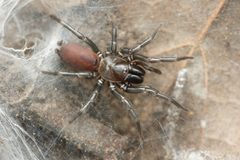
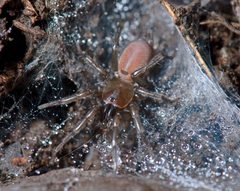
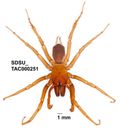
Megahexura fulva is a small mygalomorph spider native to the western United States. It constructs an exposed sheet web with a funnel-shaped retreat in holes and crevices along ravine banks. The is the sole member of the Megahexura, which was formerly placed in Mecicobothriidae but is now recognized in its own , Megahexuridae. These spiders are among the smallest mygalomorphs, with body lengths typically under 10 mm.
Pronunciation
How to pronounce Megahexura fulva: /ˌmɛɡəˈhɛksjʊrə ˈfʊlvə/
These audio files are automatically generated. While they are not always 100% accurate, they are a good starting point.
Identification
Distinguished from other small mygalomorphs by its web architecture: an exposed sheet web with a funnel-shaped retreat, rather than a burrow or trapdoor. The combination of small size, tawny coloration, and in ravine bank crevices is diagnostic. Differs from Mecicobothrium , which construct silken tubes with trapdoors in vegetation.
Images
Habitat
Holes and crevices along ravine banks; constructs webs in sheltered rocky situations. The exposed sheet web with funnel retreat is built in pre-existing cavities rather than excavated burrows.
Distribution
Native to the United States. Records indicate presence in the western U.S., including California.
Behavior
Constructs an exposed sheet web with a funnel-shaped retreat, a distinctive web architecture among mygalomorphs. The spider waits within the funnel retreat for prey to contact the sheet web.
Ecological Role
in riparian and ravine bank ; contributes to through .
Similar Taxa
- Mecicobothrium spp.Formerly classified in the same ; also small mygalomorphs, but construct silken tubes with hinged trapdoors in vegetation rather than exposed sheet webs in rock crevices
- Hexura spp.Related in Hexuridae; larger mygalomorphs with different web architecture and preferences
More Details
Taxonomic history
Megahexura was formerly classified in the Mecicobothriidae, but molecular and morphological studies led to its placement in the separate family Megahexuridae. The remains , with M. fulva as its sole .
Sources and further reading
- BugGuide
- GBIF taxonomy match
- iNaturalist taxon
- NCBI Taxonomy
- Catalogue of Life
- How Ants Do Battle: Toxic Sprays, Thick Armor, Overwhelming Numbers, and More
- Bug Eric: Two-spotted Cobweb Weaver and kin
- Seeding for Success - Buglife Blog - Buglife
- Gardening for Solitary Bees - Buglife Blog - Buglife
- How One Entomologist Followed a Passion to Understand Insect Interactions
- Coffee Berry Borers Use Gut Bacteria to Detoxify Caffeine