
Megahexuridae
Hedin & Bond, 2019
Ravine Funnel-web Spiders
Genus Guides
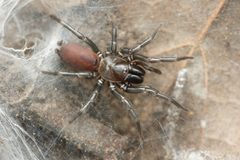
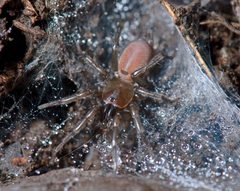
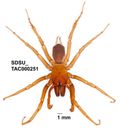
1Megahexuridae is a of spiders established in 2019, containing a single Megahexura with one described , M. fulva. These spiders are to the western United States and construct distinctive funnel-web retreats in eroded ravine banks. The family represents a relictual lineage with limited geographic distribution.
Pronunciation
How to pronounce Megahexuridae: //ˌmɛɡəˌhɛkˈsjʊrɪdiː//
These audio files are automatically generated. While they are not always 100% accurate, they are a good starting point.
Identification
The is distinguished from other mygalomorph spiders by a combination of morphological features including reduced and specific genitalic structures; field identification relies on web architecture and association with ravine microhabitats.
Images
Habitat
Restricted to eroded ravine banks with exposed soil , where spiders occupy holes and crevices in vertical or near-vertical substrates. Web construction occurs in these pre-existing cavities rather than in self-excavated burrows.
Distribution
Western United States; documented from California and possibly adjacent states. The single Megahexura has a highly restricted range consistent with relictual distribution patterns.
Behavior
Constructs exposed sheet webs with a funnel-shaped retreat positioned within holes and crevices along ravine banks; web architecture differs from burrow-dwelling mygalomorphs in utilizing existing substrate cavities rather than excavated tunnels.
Similar Taxa
- HexathelidaeAlso contains funnel-web spiders, but Megahexuridae is distinguished by reduced , specific genitalic , and exclusive association with ravine bank microhabitats rather than the ground-dwelling burrows typical of Hexathelidae.
- DipluridaeShares mygalomorph affinities and sheet-web construction, but differs in structure, genitalic features, and the specific ravine-crevice specialization of Megahexuridae.
More Details
Taxonomic history
The was erected by Hedin & Bond in 2019 based on molecular and morphological data, elevating the previously described Megahexura from its former placement. The family represents a distinct lineage within Mygalomorphae with phylogenetic affinities that required reclassification from prior familial assignments.