
Eucteniza
Ausserer, 1875
Species Guides
1- Eucteniza relata(Southwestern Trapdoor Spider)
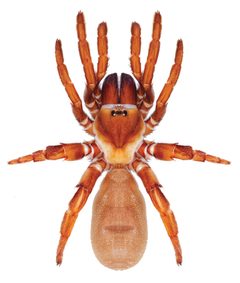
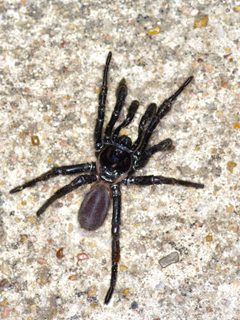
Eucteniza is a of trapdoor spiders in the Euctenizidae containing at least 14 described . These relatively large mygalomorph spiders are distributed across Mexico and the southern United States, with most species known from limited localities or single specimens. They construct silk-lined burrows with hinged, cork-like lids from which they ambush prey. The genus is characterized by distinctive morphological features including a softened and, in males, prominent mating claspers on the first two pairs of legs.
Pronunciation
How to pronounce Eucteniza: //juːkˈtɛnɪzə//
These audio files are automatically generated. While they are not always 100% accurate, they are a good starting point.
Identification
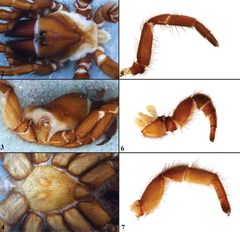
Distinguished from related by the softened, lighter-colored . Males are identified by mating claspers on both first and second leg pairs (not just the first). Females are identified by the double-toothed fang groove. -level identification requires examination of body size, limb proportions, number and arrangement of tibial spines, and shape of female sperm receptacles, combined with geographic location. Many species are known only from males or only from females, complicating identification.
Images
Appearance
Body length reaches up to 27.5 mm, making them relatively large to very large among spiders. The oval is slightly longer than wide and slopes considerably toward the rear. The third of the is relatively soft and distinctly lighter in coloration than the portion; it is often hairless and sometimes fringed with black bristles. Eight are arranged in two rows within a rectangular area: the posterior row is recurved (curved upward), while the anterior row is slightly procurved (curved downward). Coloration varies in shades of brown, with males typically dark reddish brown. The are dark brown, and the sometimes bears a dark brown blotch. Cephalothorax lengths range from 3.5 mm to 11.5 mm across .
Habitat
Predominantly desert and tropical dry forest . Burrows are constructed on flat ground or slight inclines. Elevation range spans from near sea level (8–12 m) to approximately 3,300 m. In southern Texas, E. relata has been documented burrowing in residential lawns, particularly after rains.
Distribution
Central and northern Mexico, much of Texas, and the lower Baja California Peninsula. Most are restricted to single or few localities; E. relata has the broadest documented range, though this may represent multiple cryptic species.
Seasonality
In Texas, from burrows occurs between August and January, with peak collection during this period. In Mexico, dispersal extends from June to January.
Diet
, feeding on passing arthropods. Documented prey in E. relata burrows include beetles, ants, and millipedes.
Life Cycle
Juveniles construct burrows near , suggesting limited post-hatching . Burrow bottoms accumulate molted , indicating growth occurs within the same burrow. Sexual maturity and dispersal timing varies by region.
Behavior
Constructs unbranched, silk-lined burrows 7–25 cm deep, covered with a cork-like lid of silk and soil hinged with silk. Waits at the burrow entrance to ambush passing prey. Limited in juveniles. Males use leg spines to grasp females during mating.
Ecological Role
of ground-dwelling arthropods. Prey for tarantula hawk ( Pepsis), which paralyze spiders in their burrows to provision nests.
Human Relevance
Generally difficult to encounter in the wild and rare in collections. E. relata in Texas may be noticed in residential lawns after rainfall. Not medically significant.
Similar Taxa
- EntychidesClosely related with overlapping range (Arizona to Texas into Mexico); distinguished by morphological and genetic differences per recent studies
- NeoapachellaFormerly considered closest relative based on and ; forest-dwelling in Arizona and New Mexico distinguished by and phylogenetic placement
More Details
Taxonomic History
The has undergone extensive revision, with nearly 20 named and four genera (Favila, Enrico, Astrosoga) synonymized under Eucteniza. A 2013 revision by Bond and Godwin described 12 new species and synonymized E. rex and E. stolida with E. relata. E. atoyacensis was declared a dubious name due to its .
Conservation Status
Many are known from extremely limited material (one or two localities, or single-sex specimens). The is considered poorly sampled, with additional species expected to be discovered. E. relata may represent multiple undescribed cryptic species requiring further research.
Sources and further reading
- BugGuide
- Wikipedia
- GBIF taxonomy match
- iNaturalist taxon
- NCBI Taxonomy
- Catalogue of Life
- UC Davis Professor Jason Bond Publishes Trapdoor Spider Research (And Appears on TV) | Bug Squad
- Name That Spider! | Bug Squad
- Name That Spider--And Did They Ever! | Bug Squad
- UC Davis Spider-Naming Contest: We Have a Winner! | Bug Squad