
Zodarion rubidum
Simon, 1914
European Ant-eating Spider
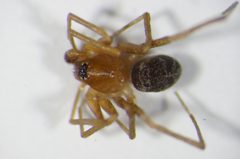
Zodarion rubidum is a small -eating spider native to southwestern France that has expanded its range across central Europe and been introduced to North America. It is a specialized myrmecophagous that employs to resemble red ants, enabling it to hunt among ant colonies. The is primarily and constructs distinctive igloo-shaped stone retreats for daytime shelter.
Pronunciation
How to pronounce Zodarion rubidum: /zoʊˈdɛəriən ˈruːbɪdəm/
These audio files are automatically generated. While they are not always 100% accurate, they are a good starting point.
Identification
Distinguished from other Zodariidae by its specific association with red ant mimicry and reddish coloration. The can be separated from congeneric -mimics by geographic origin and subtle morphological differences, though definitive identification may require examination of genitalia. The combination of small size (up to 5 mm), ground-dwelling , and ant-like appearance distinguishes it from most other small European spiders.
Images
Appearance
Habitat
Terrestrial with established colonies, particularly those of Myrmica sabuleti, Tetramorium caespitum, and Lasius platythorax. Occupies open ground where it can move freely during evening and night hours. Constructs igloo-shaped stone retreats attached to undersides of rocks or dead wood for daytime shelter.
Distribution
Native to southwestern France; expanded range includes central Europe (Austria, Belgium, and other regions). Introduced to the United States and Canada. GBIF records indicate presence in Europe and Russia (European part and Caucasus), with introduced in North America.
Seasonality
Active during evening and night hours. movement across open ground; inactivity within constructed retreats. Specific seasonal activity patterns not documented.
Diet
Exclusively myrmecophagous; preys upon ants. Documented prey includes Tetramorium caespitum and Lasius platythorax. Experimental studies demonstrate strong prey selectivity: when presented with twelve and various other insects, the spider attacked ants exclusively and ignored non-ant prey.
Host Associations
- Tetramorium caespitum - preyFrequently consumed
- Lasius platythorax - preyFrequently consumed
- Myrmica sabuleti - mimicry modelSpecific that the spider structurally and behaviorally mimics
Life Cycle
and spiderling stages develop within protective retreats. Juveniles are vulnerable to attack. Specific details of developmental stages, instar numbers, and duration not documented.
Behavior
Performs , disguising itself as ants to facilitate hunting and prey capture. wanderer active during twilight and night; remains hidden in carefully constructed igloo-shaped stone retreats during daylight. Retreats are attached to undersides of rocks or dead wood and provide protection against environmental conditions and enemies.
Ecological Role
Specialized of ants, potentially influencing local . Serves as for including Calymmochilus dispar and Gelis apterus. The spider's retreats may provide incidental shelter for other small arthropods.
Human Relevance
Subject of scientific research on mimicry and prey specialization. No documented direct economic or medical significance. Introduction to North America represents an anthropogenic range expansion.
Similar Taxa
- Zodarion styliferumCongeneric -eating spider with similar and ; distinguished by geographic distribution and subtle structural differences, with Z. styliferum occurring across Europe, Asia, and North Africa
- Other Zodariidae members share -eating specialization and ant-mimetic appearance; -level identification requires detailed examination
More Details
Prey Selectivity
Experimental studies demonstrate that Z. rubidum exhibits strong chemical and visual recognition of prey, ignoring non-ant insects even when presented simultaneously with multiple ant
Parasitoid Vulnerability
Related Z. styliferum is known to be parasitized by species Calymmochilus dispar and Gelis apterus; similar vulnerability likely applies to Z. rubidum given shared and retreat-building