
Hyptiotes puebla
Muma & Gertsch, 1964
triangle spider
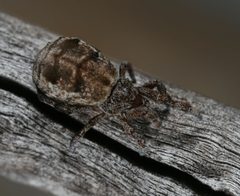
Hyptiotes puebla is a of cribellate orb-weaving spider in the Uloboridae, commonly known as triangle spiders. Like other members of its , it constructs a distinctive triangular web that represents a reduced sector of a typical orb web. The species occurs in the United States and Mexico. As a uloborid, it lacks venom glands—a unique characteristic among North American spiders—and relies on specialized silk capture mechanisms to subdue prey.
Pronunciation
How to pronounce Hyptiotes puebla: /hɪpˈti.oʊtiːz ˈpwɛblə/
These audio files are automatically generated. While they are not always 100% accurate, they are a good starting point.
Identification
Hyptiotes puebla belongs to a distinguished by its triangular web architecture, though -level identification requires examination of morphological details not provided in available sources. The genus Hyptiotes can be separated from other uloborids by the triangular rather than complete orb web shape. Among North American Hyptiotes, three species are chiefly western in distribution, while H. cavatus is the sole eastern species; H. puebla's specific geographic range and distinguishing features relative to other western species are not documented in available literature.
Images
Habitat
Based on -level characteristics, Hyptiotes construct webs about waist-high in weeds, on bridges and other structures, and on twigs of trees and shrubs. Specific preferences for H. puebla have not been documented.
Distribution
United States and Mexico. GBIF records confirm distribution in both countries.
Behavior
As a member of the Hyptiotes, H. puebla likely exhibits the characteristic hunting where the spider sits on the anchor thread near the web apex and releases tension when prey strikes the web, causing the web to rebound and further entangle the victim. This behavior has been documented for the genus but not specifically confirmed for H. puebla.
Similar Taxa
- Hyptiotes cavatusThe sole eastern North American of Hyptiotes; H. puebla occurs in the western United States and Mexico, allowing geographic separation where ranges do not overlap.
- Uloborus speciesOther uloborid spiders that construct complete orb webs rather than the reduced triangular webs of Hyptiotes; also differ in web architecture and resting posture.
More Details
Cribellate silk
As a cribellate spider, Hyptiotes puebla possesses a cribellum—an additional spinning organ that produces specialized silk combed into tangled threads using the calamistrum on the hind legs. This silk is not adhesive but relies on mechanical entanglement to capture prey.
Non-venomous status
Uloboridae, including H. puebla, are the only spiders in North America that lack venom glands entirely. Prey subduction relies entirely on silk wrapping and probable enzymatic digestion through extra-oral processing.