
Xysticus triguttatus
Keyserling, 1880
Three-banded Crab Spider
Xysticus triguttatus, commonly known as the three-banded crab spider, is a small ambush-hunting spider in the Thomisidae. The is widely distributed across North America, with records from the United States and Canada including Alberta, Manitoba, and Saskatchewan. As a member of the Xysticus, it exhibits the characteristic crab-like posture and hunting typical of ground crab spiders, lying in wait for prey rather than constructing webs.
Pronunciation
How to pronounce Xysticus triguttatus: //zɪsˈtiːkəs traɪˈɡʌtətəs//
These audio files are automatically generated. While they are not always 100% accurate, they are a good starting point.
Identification
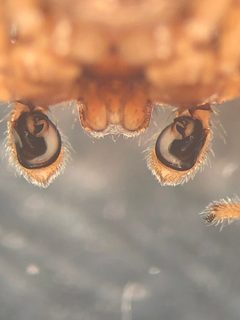
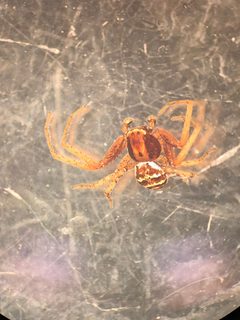
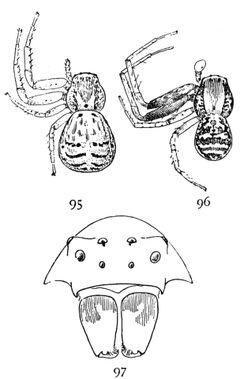
Can be distinguished from other Xysticus by the three-banded or three-spotted pattern referenced in its specific epithet. Differentiated from similar ground crab spiders by the combination of its North American distribution and particular abdominal markings. Distinguished from the related running crab spiders (Philodromidae) by its more compact body form and typical ground-dwelling habits rather than foliage-dwelling .
Images
Habitat
Found in a variety of terrestrial across its North American range. Like other Xysticus , it occupies ground-level environments including leaf litter, grasses, and low vegetation where it can ambush passing insects.
Distribution
North America: United States and Canada. Canadian provincial records include Alberta, Manitoba, and Saskatchewan. The has a transcontinental distribution across northern North America.
Seasonality
and immatures have been observed active in spring, with records from early March in temperate regions. As a temperate , it likely overwinters as adults or immatures in protected locations such as leaf litter or at the base of grass tussocks.
Life Cycle
Behavior
Ambush that waits motionless for prey to come within reach of its elongated front legs. Does not construct capture webs. Has been observed engaging in ballooning for , climbing vertical objects and releasing silk threads to catch wind currents. Exhibits cryptic behavior, readily retreating to cracks or cover when disturbed.
Ecological Role
of small insects and other arthropods. Contributes to regulation of ground-dwelling insect . Serves as prey for larger and vertebrates including spider wasps (Pompilidae) such as Dipogon , which are known to hunt Xysticus spiders.
Human Relevance
Not medically significant; bite is not considered dangerous to humans. May be encountered in gardens and natural areas but poses no threat. Contributes to of insect pests in agricultural and natural settings.
Similar Taxa
- Xysticus other speciesMany Xysticus share similar ground crab spider and habits; precise identification requires examination of genitalia and specific pattern details.
- Philodromus species (Philodromidae)Running crab spiders have similar crab-like posture but are typically found on vegetation rather than ground, with more elongated bodies and different arrangements.
- Ozyptila speciesAnother of small crab spiders with similar ambush hunting ; distinguished by subtle morphological differences in leg spination and body proportions.
More Details
Ballooning behavior
Xysticus triguttatus has been documented engaging in ballooning, a where spiders climb vertical objects, release silk threads, and allow wind currents to carry them aloft. This behavior is most commonly observed in spiders but can occur in small as well.
Nomenclature
The specific epithet 'triguttatus' derives from Latin 'tri-' (three) and 'guttatus' (spotted or drop-like), referring to three characteristic markings on the .
Sources and further reading
- BugGuide
- Wikipedia
- GBIF taxonomy match
- iNaturalist taxon
- NCBI Taxonomy
- Catalogue of Life
- Publications | Entomology Research Museum
- Bug Eric: ArachNovember?
- Bug Eric: Spider wasp, Dipogon calipterus
- Bug Eric: Spider Sunday: Spring Spiders
- Bug Eric: One Night, One House, Seventeen Spider Species
- Bug Eric: Ballooning Spiders