
Episinus
Walckenaer, 1809
Square-ended Cobweb Spiders
Species Guides
1- Episinus amoenus(cobweb spider)
Episinus is a of comb-footed spiders in the Theridiidae, first described by Walckenaer in 1809. The genus includes approximately 64 described distributed across Asia, Africa, and the Americas, with 16 species recorded from China. These small spiders are known for their highly reduced, H- or Y-shaped webs constructed near ground level in low vegetation. Several species have conservation significance, including the Tree H-weaver (Episinus maculipes) which is Red Data Book listed in the UK.
Pronunciation
How to pronounce Episinus: //ˈɛpɪˌsaɪnəs//
These audio files are automatically generated. While they are not always 100% accurate, they are a good starting point.
Identification
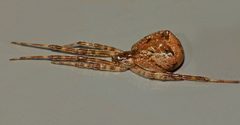
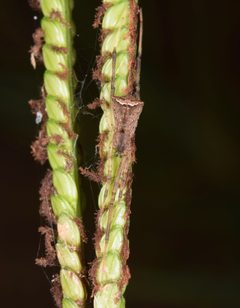
Distinguished from other Theridiidae by the combination of: highly reduced H- or Y-shaped webs; with distinct fovea and often horn-like projections between ; with humps and ; circular eye arrangement on tubercles with median eyes smallest; and characteristic resting posture with first two pairs of legs extended forward and last two pairs stretched backward. The low, flat, anteriorly projecting and specific leg formula (1423 or 4123) further separate Episinus from similar .
Images
Habitat
Found at ground level between low vegetation, in evergreen shrubs, or in leaf litter in forest areas. Webs constructed very close to ground level.
Distribution
Worldwide distribution with recorded from Asia, Africa, and the Americas. In China, 16 described species occur mainly in southern provinces (Yunnan, Guizhou, Guangxi, Hunan, Hubei, Jiangxi, Sichuan, Taiwan, Zhejiang) with two species in northern China (Gansu, Shaanxi). Additional records from Israel, South Africa, Angola, and Europe (Denmark, Norway).
Seasonality
Courtship has been observed in summer. No other seasonal activity patterns documented.
Behavior
Constructs highly simplified webs consisting of only two or three threads forming H- or Y-shaped structures near ground level. When resting, extends first two pairs of legs forward and stretches last two pairs backward. Body coloration with black, brown and white spots provides camouflage against substrate.
Human Relevance
Episinus maculipes (Tree H-weaver) is Red Data Book listed in the UK and has been a focus of conservation efforts, including successful campaigns to protect its at Radford Quarry in Plymouth from development. The has contributed to public discourse on biodiversity protection and the moral responsibility to prevent extinction.
Similar Taxa
- TheridionBoth are Theridiidae with comb-footed , but Episinus has highly reduced H- or Y-shaped webs versus more extensive cobwebs, and distinctive horn-like projections and tuberculate not typical of Theridion
- ArgyrodesBoth Theridiidae with small body size, but Argyrodes are often kleptoparasitic in other spiders' webs and lack the characteristic reduced web structure and specific / of Episinus
More Details
Species diversity
As of 2025, the includes 64 described with five proposed species groups for Chinese Episinus based on morphological characteristics. Recent taxonomic work has described new species from Jiangxi, Yunnan, and Shaanxi Provinces.
Conservation significance
The protection of Radford Quarry for Episinus maculipes and the critically endangered Nothophantes horridus (Horrid ground-weaver) represents a notable case where biodiversity concerns successfully halted development, with the planning inspector upholding the decision primarily on biodiversity grounds.
Sources and further reading
- BugGuide
- Wikipedia
- GBIF taxonomy match
- iNaturalist taxon
- NCBI Taxonomy
- Catalogue of Life
- Horrid ground-weaver saved – Thanks mainly to Buglife, Plymouth City Council and you! - Buglife Blog - Buglife
- Notes on the butterfly theridiid Episinus marignaci (Lessert, 1933) (Araneae, Theridiidae) from South Africa
- On new spider species of the genus Episinus (Araneae, Theridiidae) from China and proposal of five species groups
- Spiders of the generaEpisinus, ArgyrodesandCoscinidafrom Israel, with additional notes ORTheridion(Araneae: Theridiidae)
- Description and phylogenetic analysis of two new Episinus (Araneae, Theridiidae) species from China.