
Crustulina
Menge, 1868
Species Guides
2- Crustulina altera(cobweb spider)
- Crustulina sticta(Brownblack Cobweb Weaver)
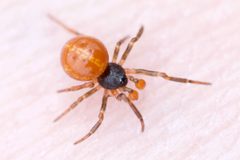
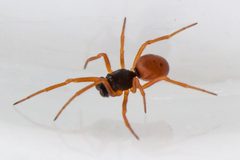
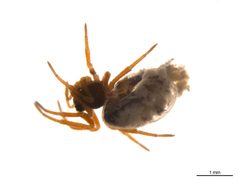
Crustulina is a of comb-footed spiders (Theridiidae) established by Anton Menge in 1868. The genus comprises 17 distributed across Oceania, Africa, Asia, North America, and Europe. Members of this genus are small cobweb weavers that construct tangled webs in sheltered locations. The type species, Crustulina guttata, has been studied for its potential beyond its native European range.
Pronunciation
How to pronounce Crustulina: //ˌkrʌs.tjuːˈlaɪ.nə//
These audio files are automatically generated. While they are not always 100% accurate, they are a good starting point.
Identification
Crustulina are small theridiid spiders that may be distinguished from related such as Steatoda by subtle morphological features. Crustulina guttata exhibits distinct white spots on the that reduce misidentification risk despite its small size. Detailed identification requires examination of genitalic structures and comparison with . The genus was historically confused with Steatoda, and some species were formerly classified under that genus.
Images
Habitat
Crustulina guttata has been documented in grasslands and sand dunes, constructing small webs in vegetation close to the ground. Other occupy varied across their broad geographic ranges, including sheltered human structures such as basements and cellars in North American of certain species.
Distribution
The has a broad distribution spanning Oceania, Africa, Asia, North America, and Europe. Individual show more restricted ranges: Crustulina guttata occurs in Europe, the Caucasus, Russia (Europe to South Siberia), Central Asia, China, Korea, and Japan, with relatively recent documentation in South Korea (first identified 2001). Crustulina sticta ranges across North America, Europe, Turkey, the Caucasus, Russia (Europe to Far East), Kazakhstan, Iran, Central Asia, China, Korea, and Japan. Crustulina altera is restricted to the USA. Distribution records from GBIF confirm presence in Denmark, Norway, and Sweden.
Seasonality
Crustulina guttata are active from June to August. Activity periods for other vary by region and climate.
Behavior
Members of this construct irregular, tangled cobwebs with sheet-like central platforms. The spiders typically hang upside down in their webs. When disturbed, individuals may drop from the web and retreat into nearby crevices. Some build webs in close proximity to other cobweb weavers, including Steatoda and cellar spiders.
Human Relevance
Some Crustulina , particularly those , are frequently encountered in human dwellings including basements, garages, and cellars. They are not recognized as dangerously venomous to humans or pets. Due to their small size, their bite is unlikely to puncture human skin. They may contribute to control of indoor insect populations.
Similar Taxa
- SteatodaHistorically confused with Crustulina; several Crustulina were formerly classified in Steatoda. Both are theridiid cobweb weavers with similar web architecture and preferences. Steatoda includes larger species such as the triangulate cobweb weaver (S. triangulosa) and false widows.
- AsagenaFormerly classified within Steatoda alongside some Crustulina ; shares theridiid characteristics and small body size. Asagena species such as A. americana and A. fulva occupy similar ground-level under stones and debris.
- ParasteatodaAnother theridiid with similar cobweb-weaving and tendencies; includes the common house spider (P. tepidariorum) which may be confused with small Steatoda and Crustulina in domestic settings.
More Details
Taxonomic history
The Crustulina has undergone significant taxonomic revision. Herbert W. Levi's 1957 work "The Spider Genera Crustulina and Steatoda in North America, Central America, and the West Indies" clarified boundaries between these genera. Several were transferred between Crustulina and Steatoda, and synonymies were established for multiple names.
Species diversity
As of May 2020, the contains 17 described . The type species is Crustulina guttata (Wider, 1834). Notable synonyms include C. borealis, C. pallipes, and C. rugosa, all now synonymized under C. sticta.
Research significance
Crustulina guttata has served as a test case for climate envelope modeling methodology, specifically regarding variable selection in Random Forest models. This research suggested the may have been artificially dispersed beyond its native European range, though this hypothesis requires further confirmation.
Sources and further reading
- BugGuide
- Wikipedia
- GBIF taxonomy match
- iNaturalist taxon
- NCBI Taxonomy
- Catalogue of Life
- Bug Eric: Spider Sunday: Triangulate Cobweb Weaver
- Bug Eric: Two-spotted Cobweb Weaver and kin
- Do Random Forest-Driven Climate Envelope Models Require Variable Selection? A Case Study on Crustulina guttata (Theridiidae: Araneae)