
Asagena
Sundevall, 1833
Species Guides
4- Asagena americana(Two-spotted Cobweb Spider)
- Asagena fulva(Red-and-white Asagena)
- Asagena medialis
- Asagena pulcher
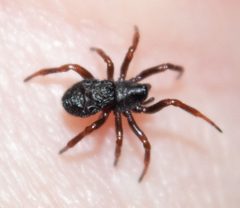
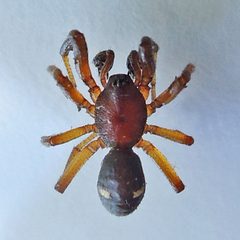
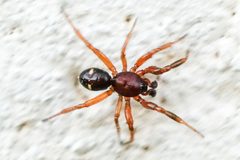
Asagena is a of cobweb spiders ( Theridiidae) established by Carl Jakob Sundevall in 1833. It comprises nine distributed across North America, Europe, Asia, and North Africa. Members are small spiders (2.4–5.9 mm body length) that construct webs in sheltered microhabitats including under stones, in leaf litter, under bark, and in moss. The genus was formerly classified within Steatoda.
Pronunciation
How to pronounce Asagena: /ˌæsəˈdʒiːnə/
These audio files are automatically generated. While they are not always 100% accurate, they are a good starting point.
Identification
Small, stout-bodied cobweb spiders with body lengths generally under 6 mm. Males typically have short, muscular legs with the underside of each bearing short teeth and/or spurs; females are more delicate in build. Males of at least one (A. americana) possess a stridulating organ on each side of the near the , with a semicircular hardened plate on the that rubs against these organs to produce sound. Some species display characteristic color patterns: A. americana has two spots, while A. fulva appears redder with more white markings.
Images
Habitat
Sheltered terrestrial microhabitats including under stones, among leaf litter, under bark on decaying logs, in moss, and at the edges of nests. Some occur in arid environments such as the Sonoran Desert.
Distribution
Holarctic distribution spanning North America (Canada, USA, Mexico), Europe, Asia (Russia, Kazakhstan, China, Korea, Mongolia, Iran, Central Asia), and North Africa (Algeria). Individual show varying ranges: A. phalerata is the most widespread (Europe through Russia to Far East, Turkey, Caucasus, Central Asia, China, Korea); A. americana occurs across most of North America with disjunct records in China; A. fulva and A. medialis in southwestern and central North America; A. italica in France, Switzerland, Italy, and Algeria; A. meridionalis in central to southeastern Europe and Georgia; A. semideserta in Kazakhstan and Mongolia.
Seasonality
Activity periods vary by and sex. Males of A. americana are most commonly encountered in spring (May–July), females May–August. This represents an unusual seasonal pattern as most male spiders wander in autumn.
Life Cycle
Mated females produce spherical, translucent sacs 4–5 mm in diameter containing 20–30 pale yellow eggs. Females of A. americana have been observed with egg sacs from May through August.
Behavior
Males of A. americana possess a stridulating mechanism used to produce sound, with organs on the and a hardened abdominal plate that rub together. A. fulva has been observed constructing webs at the edges of nests, suggesting possible specialization on ants as prey. Both sexes of A. americana are frequent victims of by Black and Yellow Mud Dauber (Sceliphron caementarium), which paralyze them to provision nest for larval food.
Ecological Role
Prey for spider wasps including mud daubers. Potential where associate with ant nests.
Similar Taxa
- SteatodaFormerly classified within this ; distinguished by revised taxonomic placement based on morphological and phylogenetic studies by Levi (1957) and subsequent .
- CrustulinaRelated theridiid discussed in same taxonomic revisions; Asagena distinguished by specific genitalic and somatic characters detailed in systematic treatments.