
Asagena americana
Emerton, 1882
Two-spotted Cobweb Spider, Twospotted Cobweb Spider
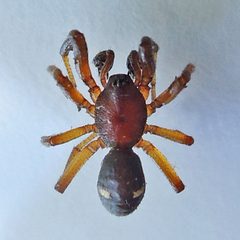
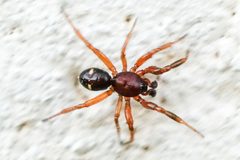
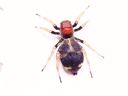
Asagena americana, commonly known as the two-spotted cobweb spider, is a small theridiid spider native to North America. Males are notably robust with short, muscular legs and possess a stridulating organ used to produce sound during courtship. Females construct cobwebs in concealed microhabitats including under stones, in leaf litter, under bark, and in moss. The exhibits pronounced in body form and is frequently preyed upon by mud dauber .
Pronunciation
How to pronounce Asagena americana: /ˈæsəˌdʒiːnə əˌmæɹɪˈkeɪnə/
These audio files are automatically generated. While they are not always 100% accurate, they are a good starting point.
Identification
Males distinguished from females by stout body, short muscular legs with toothed/spurred , and presence of stridulating organs on rear . Females identified by more delicate build and association with cobwebs in concealed . Distinguished from ground-dwelling spiders by theridiid arrangement and web-building ; from other Asagena by specific genitalic characters (not detailed in available sources). Formerly classified in Steatoda, which contains several mistaken for black widows.
Images
Habitat
Females occupy cryptic microhabitats: under stones, among leaf litter, under bark on decaying logs, and in moss. Males wander in search of females. include concrete bike paths, parks, and presumably natural areas with suitable cover objects.
Distribution
North America: United States and Canada (including Alberta). Records also indicate presence in China, though this may represent introduction or misidentification. Ranges across most of North America per Eric source.
Seasonality
males active primarily spring through early summer, collected May through July. Females active May through August. Peak activity in spring distinguishes this from most male spiders that wander in autumn.
Life Cycle
Mated females produce spherical, translucent sacs 4-5 mm in diameter containing 20-30 pale yellow eggs. Egg sacs deposited in or near female's web in concealed location. Developmental details beyond egg stage not documented in available sources.
Behavior
Males produce sound through stridulation: semicircular hardened plate on rubs against stridulating organs on rear to create audible signals. Males wander to find females, unlike most theridiids where males stay near webs. Both sexes frequently captured by Black and Yellow Mud Dauber (Sceliphron caementarium or similar), which sting them into paralysis and provision nests for larval offspring.
Ecological Role
in leaf litter and ground-level . Prey base unknown but presumably small captured in cobwebs. Serves as significant prey item for mud dauber , indicating role in supporting higher .
Human Relevance
Minimal direct interaction with humans. Not medically significant. May be encountered by naturalists and entomologists in field settings, particularly on paths and trails where males wander. Former confusion with Steatoda (which contains resembling black widows) may have generated misidentifications.
Similar Taxa
- Asagena fulvaRelated common in southwestern U.S., north to Oregon and east to Florida; slightly larger (females 3-5.9 mm, males 2.4-5 mm), appears 'redder' with more white markings, and may specialize on ants as prey. Found under stones, garbage barrels, and other cover.
- Steatoda speciesFormerly classified in this ; several Steatoda are frequently mistaken for black widows (Latrodectus), though A. americana itself is not among those confused with medically significant species.
More Details
Taxonomic History
formerly placed in Steatoda; transferred to Asagena based on morphological and phylogenetic studies. This reclassification reflects refined understanding of theridiid relationships.
Acoustic Communication
Stridulatory apparatus in males represents unusual sound production mechanism among spiders, which typically rely on visual and vibrational signals. The precise function of male stridulation (courtship, territorial, or other) is not explicitly documented in available sources.
Sources and further reading
- BugGuide
- Wikipedia
- GBIF taxonomy match
- iNaturalist taxon
- NCBI Taxonomy
- Catalogue of Life
- Bug Eric: April 2015
- Deerly departed: food for flesh-recycling carrion beetles - Margined carrion beetle, Oiceoptoma noveboracense, and American carrion beetle, Necrophila americana — Bug of the Week
- Unwelcome guests in Hawai’i: American cockroach, Periplaneta americana, German cockroach, Blattella germanica, and Western yellowjacket, Vespula pensylvanica — Bug of the Week
- As a Watershed is Urbanized, Damselflies Show Declines
- Silphidae | Beetles In The Bush
- Explorer or Wallflower? Study Shines Light on Cockroach Personalities