
Scytodes atlacoya
Rheims, Brescovit & Durán-Barrón, 2007
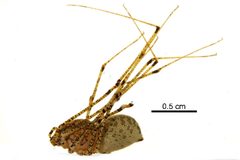
Scytodes atlacoya is a of spitting spider in the Scytodidae, first described from Mexico in 2007. Like other members of its , it possesses the distinctive ability to eject sticky venom from its fangs to immobilize prey. The species belongs to a family characterized by six arranged in three pairs and a highly convex that accommodates enlarged venom glands. As a relatively recently described species, detailed natural history information specific to S. atlacoya remains limited.
Pronunciation
How to pronounce Scytodes atlacoya: //sɪˈtoʊdiːz ætˈləkoʊjə//
These audio files are automatically generated. While they are not always 100% accurate, they are a good starting point.
Identification
As a member of Scytodidae, S. atlacoya would share the 's diagnostic features: six in three dyads (pairs), a strongly convex , and long, slender legs. The was described from Mexico, distinguishing it geographically from similar . Specific identification requires examination of genitalic structures, as spitting spiders generally lack the conspicuous external markings that characterize some other spider families. S. atlacoya may be distinguished from the widespread S. thoracica and other North American species by subtle morphological differences and geographic origin.
Images
Distribution
Mexico (type locality). The is known from the region where it was originally described.
Similar Taxa
- Scytodes thoracicaThe most widely distributed spitting spider in North America, ranging from Canada to at least Missouri and Iowa; distinguished by markings and smaller body size (females 4-6 mm). S. atlacoya is known only from Mexico and was described more recently.
- Scytodes longipesAn introduced in North America with longer body size (6-8 mm); S. atlacoya may overlap in size but differs in native distribution and presumably in detailed .
More Details
Taxonomic note
Scytodes atlacoya was described by Rheims, Brescovit & Durán-Barrón in 2007, making it one of the more recently recognized in a that likely contains numerous undescribed . The genus Scytodes contains both 'long-legged' species that construct tangled sheet webs and 'short-legged' ground-dwelling species that do not build webs.
Family characteristics
Members of Scytodidae possess divided venom glands: the lobe contains traditional paralytic venom, while the lobe produces a glue-like substance ejected as sticky threads that solidify and contract to bind prey. This remarkable prey capture mechanism is shared across the and has been documented to occur in approximately 30 milliseconds.