
Talavera minuta
(Banks, 1895)
Minute Jumping Spider
Talavera minuta is a small jumping spider in the Salticidae. It is one of the smallest members of its , with an body length of approximately 2-3 mm. The has a transcontinental distribution spanning eastern Russia and North America. Like other salticids, it possesses excellent vision and active hunting , though specific ecological details remain poorly documented.
Pronunciation
How to pronounce Talavera minuta: //tɑːɫəˈvɛ.rə mɪˈnuː.tə//
These audio files are automatically generated. While they are not always 100% accurate, they are a good starting point.
Identification
Distinguished from other Talavera primarily by its extremely small size. Talavera minuta is notably smaller than such as T. petrensis and T. aequipes. The combination of minute body size, compact body proportions, and the characteristic arrangement of Salticidae (two large eyes) allows identification to . Definitive species-level identification may require examination of genitalic structures under magnification.
Images
Appearance
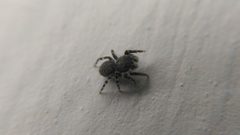
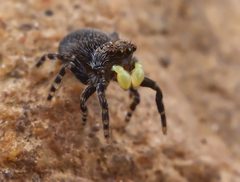
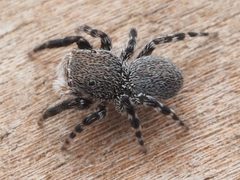
Extremely small jumping spider with body length typically 2-3 mm. The and are compact relative to leg length. Coloration is generally muted with subtle patterning. The are disproportionately large compared to body size, characteristic of the . The legs are relatively long and slender for the body proportions. in coloration and pattern has been noted but is subtle.
Habitat
Found in open, dry including grasslands, meadows, and rocky areas. Occurs at ground level and on low vegetation. Specific microhabitat preferences within these general categories are not well documented.
Distribution
Eastern Russia (East Siberia, Far East), Canada (including Alberta), and the United States. The transcontinental distribution across Beringia suggests a historical connection between Palearctic and Nearctic .
Seasonality
have been recorded from spring through fall in North American . Specific patterns are not well documented.
Behavior
Active hunter relying on vision to locate prey. Typical of salticid jumping spiders, it stalks prey and pounces from short distances. Specific behavioral observations beyond general characteristics are limited due to the ' small size and cryptic habits.
Ecological Role
Likely functions as a of small arthropods in ground-level and low vegetation . Given its minute size, prey items are probably restricted to very small insects and other arthropods.
Human Relevance
No documented economic or medical significance. Occasionally encountered by arachnologists and naturalists during systematic surveys. The name 'minuta' refers to its small size.
Similar Taxa
- Talavera petrensisLarger body size (approximately 4-5 mm); otherwise similar in general appearance and preference
- Talavera aequipesLarger and more robust build; overlapping distribution in some regions
- Other small Salticidae genera (e.g., Neon, Sitticus)Similar minute size and general appearance; distinguished by arrangement details and genitalic
More Details
Taxonomic history
Originally described by Nathan Banks in 1895. The Talavera was established relatively recently (1980s), with previously assigned to other genera. The transcontinental distribution pattern is shared with several other Holarctic spider species.
Conservation status
Not evaluated by IUCN. Widespread distribution and use suggest it is not currently of conservation concern, though specific trends are unknown.
Sources and further reading
- BugGuide
- Wikipedia
- GBIF taxonomy match
- iNaturalist taxon
- NCBI Taxonomy
- Catalogue of Life
- Tiny raptors: Mantisflies, Mantispidae, and Praying mantises, Mantidae — Bug of the Week
- Bug Eric: Last Night to Blacklight?
- For an Understudied Ant Genus, Two Researchers Choose a "Bird Guide" ID Tool
- Bug Eric: October 2022
- Uncategorized | Blog - Part 12