
Synemosyna
Hentz, 1846
Species Guides
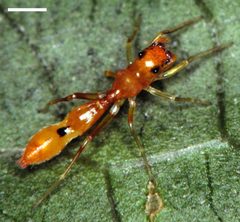
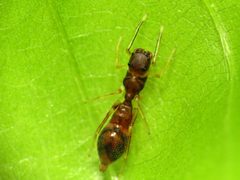
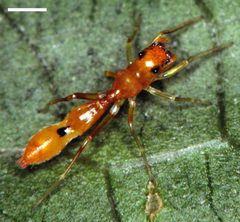
2- Synemosyna formica(Ant-mimic jumping spider)
- Synemosyna petrunkevitchi
Synemosyna is a of ant-mimicking jumping spiders in the Salticidae. First described by Nicholas Marcellus Hentz in 1846, the genus contains approximately twenty distributed from the northern United States through Central America to Argentina. These spiders exhibit of ants, a defensive that reduces . The type species is Synemosyna formica.
Pronunciation
How to pronounce Synemosyna: //sɪˌnɛmɒˈsaɪnə//
These audio files are automatically generated. While they are not always 100% accurate, they are a good starting point.
Identification
Synemosyna are distinguished from other jumping spiders by their pronounced mimicry, including an elongated, narrow body form and often a constricted waist-like appearance. The and are typically slender and elongated compared to most salticids. They possess the enlarged characteristic of Salticidae, but these may be less conspicuous due to the ant-like body shape. Specific species identification requires examination of genitalic and detailed pattern differences.
Images
Distribution
The occurs from the northern United States (including Vermont) south through Mexico, Central America, and the Caribbean to South America, reaching as far south as Argentina. Individual have more restricted ranges: S. formica is found in the USA, S. americana ranges from Mexico to Venezuela, and several species are to Brazil, Colombia, or other single countries.
Behavior
Ecological Role
As mimics, these spiders may occupy where ant avoidance by provides protection. They function as predators within their .
Similar Taxa
- MyrmarachneAnother large of ant-mimicking jumping spiders; Myrmarachne often have more pronounced cheliceral elongation in males and different genitalic structures, though visual distinction in the field can be difficult.
- Peckhamia-mimicking salticid with similar body form; distinguished by details of arrangement and genitalic .
More Details
Taxonomic history
The was established by Hentz in 1846 with Synemosyna formica as the type . Several species were transferred from other genera, including some originally described in Salticus and other early salticid genera.
Species diversity
As of August 2019, the contained twenty described , with the majority occurring in Central and South America. Several species have been described relatively recently (1985–2006), suggesting ongoing taxonomic work.