
Lyssomanes viridis
(Walckenaer, 1837)
magnolia green jumper, magnolia green jumping spider
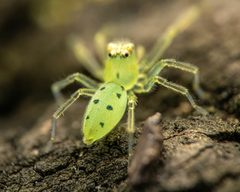
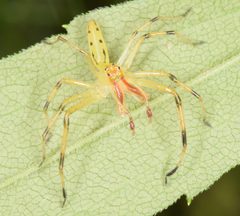
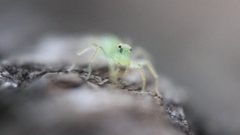
Lyssomanes viridis, the magnolia green jumper, is a small jumping spider native to the southeastern United States. It is the type of the Lyssomanes, considered one of the earliest-evolved genera of jumping spiders. The species exhibits distinctive pale green coloration, elongated legs relative to body size, and specialized visual cognition . Males engage in visual agonistic displays using brightly colored and forelegs, while both sexes utilize visual, vibratory, and pheromonal signals for communication.
Pronunciation
How to pronounce Lyssomanes viridis: /ˌlɪsəˈmeɪniːz ˈvɪrɪdɪs/
These audio files are automatically generated. While they are not always 100% accurate, they are a good starting point.
Identification
Pale green coloration distinguishes it from most North American jumping spiders; longer legs and smaller jump distance relative to body size compared to typical salticids; colored crown (red, orange, yellow, or white) framing ; males with conspicuously colored and forelegs. Distinguished from similar green salticids by combination of translucent green body, crown scale coloration, and lyssomanine eye arrangement.
Images
Habitat
Broad-leaved trees and shrubs, particularly magnolia in warm, humid forests; also oak, maple, pine, and other trees; bushes lower to the ground in drier climates
Distribution
Southeastern United States: Texas, Louisiana, Alabama, Mississippi, Tennessee, Arkansas, Florida, Georgia, South Carolina, North Carolina, Virginia, Maryland, and District of Columbia; rarer sightings west to Colorado; particularly abundant in Florida citrus orchards
Seasonality
Active spring through summer; matings occur in spring (particularly May); laid as late as July; females guard eggs until hatching then die (August); sub- overwinter on trees, completing development early spring
Diet
Life Cycle
laid on underside of leaves (25–70 per clutch, pale green); females guard eggs until hatching; sub- overwinter on trees; development completes in early spring; one annually with overlapping cohorts
Behavior
Males wave forelegs and approach each other during agonistic encounters; physical fights involve pressing and forelegs against opponent until one retreats; uses visual, vibratory, and pheromonal signals for identification and communication; constructs broad, sheet-like nests that assist in prey capture by temporarily immobilizing prey; lunges at prey from close range rather than typical salticid jumping pursuit
Ecological Role
of small arthropods inhabiting vegetation; contributes to regulation of mite, , and on trees and shrubs
Human Relevance
Subject of behavioral and sensory research due to primitive phylogenetic position within Salticidae; no documented agricultural or medical significance
Similar Taxa
- Other Lyssomanes speciesShared characteristics including elongated legs, pale coloration, and lyssomanine ; L. viridis distinguished by specific crown coloration and geographic range
- Typical salticid jumping spiders (e.g., Phidippus, Salticus)L. viridis has proportionally longer legs, smaller relative jump distance, and less hunting ; constructs sheet-like nests rather than typical salticid silk retreats
- Green crab spiders (Thomisidae)Superficial color similarity; L. viridis distinguished by jumping spider arrangement, active hunting , and salticid body plan
Sources and further reading
- BugGuide
- Wikipedia
- GBIF taxonomy match
- iNaturalist taxon
- NCBI Taxonomy
- Catalogue of Life
- Snakeweed Grasshopper
- Cudweed Grasshopper
- Grasshoppers of Colorado
- Grasshoppers of Colorado
- Green Light: New ID Test Ready for Invasive Mealybug Pest
- Here We Go Again: Another Invasive Pest in Florida Citrus
- Pheromones exert top-down effects on visual recognition in the jumping spiderLyssomanes viridis
- Comparative study of the display and mating behaviour of lyssomanine jumping spiders (Araneae: Salticidae), especially Asemonea tenuipes, Goleba puella , and Lyssomanes viridis
- A comparative study of Old and New World Lyssomanines (Araneae, Salticidae): Utilisation of silk and predatory behaviour of Asemonea tenuipes and Lyssomanes viridis