
Habronattus pyrrithrix
(Chamberlin, 1924)
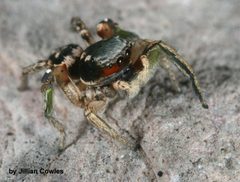
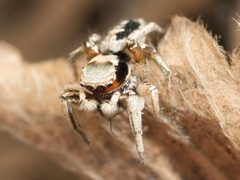
Habronattus pyrrithrix is a small jumping spider in the Salticidae, native to the southwestern United States and western Mexico. Males display striking with bright red facial coloration and green legs used in complex multimodal , while females are larger with cryptic brown and grey coloration. The exhibits trichromatic vision and uses color cues when foraging, actively avoiding red and yellow prey that may signal chemical defenses. Males employ visual, vibratory, and seismic signals during courtship to reduce female aggression and risk.
Pronunciation
How to pronounce Habronattus pyrrithrix: /hæbroʊˈnætəs pɪˈrɪθrɪks/
These audio files are automatically generated. While they are not always 100% accurate, they are a good starting point.
Identification
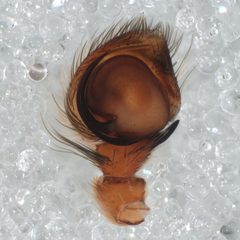
Males distinguished by bright red facial coloration and green legs, unique among sympatric Habronattus ; females identified by larger size and cryptic uniform brown-grey coloration. Males may be confused with other Habronattus species but combination of red and green legs is diagnostic. Females difficult to distinguish from other Habronattus females without close examination. Look for bold black stripes in males, which serve no courtship function but aid in deception.
Images
Habitat
Grassy areas with plant litter cover; riparian zones near bodies of water; open to shaded environments. Ground-dwelling rather than arboreal, found on stones and amid leaf litter in areas of scattered vegetation.
Distribution
Southwestern United States (Arizona, Colorado, New Mexico, Texas, California, Nevada, Utah) and western Mexico; introduced to Hawaii. Center of abundance in southwestern U.S. deserts and grasslands.
Diet
Life Cycle
Females lay sacs from which spiderlings emerge; spiderlings raised individually in laboratory settings; in coloration apparent by approximately 4mm body length. Lab-reared derived from multiple females to maintain genetic diversity.
Behavior
Males employ elaborate multimodal combining visual signals (leg waving, zig-zag approach movements), substrate-borne vibrations, and seismic signals produced by striking against substrate. Courtship occurs across open to shaded ; visual displays more effective in sunlight, with vibratory signals becoming more important in shade. Males remain front-facing toward females during approach to maintain visual contact. Females may move during displays, prompting male reliance on multiple signal modalities. Males court any encountered female, occasionally leading to interspecific aggression. Females exhibit higher aggression toward males in better condition, potentially as quality assessment mechanism. Males use black stripes and leg-waving to mimic or , deceiving ; this predator deception accompanies higher male movement rates during mate search.
Ecological Role
Terrestrial serving as on aposematic signal evolution in prey ; preyed upon by larger jumping spiders such as Phidippus californicus. Males' conspicuous coloration and movement patterns may influence predator-prey dynamics in open .
Human Relevance
Subject of behavioral research on , multimodal communication, and -prey interactions; notable for complex courtship sophistication among .
Similar Taxa
- Other Habronattus speciesSympatric share ground-dwelling habits and male ornamentation, but H. pyrrithrix males uniquely combine red facial coloration with green legs; female H. pyrrithrix distinguished by specific size and coloration patterns requiring expert examination
- Phidippus californicusKey of H. pyrrithrix; larger jumping spider that may be mistaken for H. pyrrithrix at distance but distinguished by different color patterns and substantially larger size
More Details
Visual System
Possesses trichromatic vision with long-wavelength discrimination, enabling color-based foraging decisions; innate color with highest attack rates on blue prey and lowest on red/yellow prey
Sexual Cannibalism
Females occasionally cannibalize males during courtship; this represents sexual conflict benefiting only females nutritionally while males gain no advantage from being consumed
Condition-Dependent Signaling
Male color brightness reflects diet quality and age, serving as honest signal to females during mate assessment, though color alone does not guarantee mating success
Sources and further reading
- BugGuide
- Wikipedia
- GBIF taxonomy match
- iNaturalist taxon
- NCBI Taxonomy
- Catalogue of Life
- Bug Eric: What a Spider!
- Bug Eric: Spider Sunday: Another Jumper
- Bug Eric: A Case of Predator Mimicry in the Bee Fly Genus Epacmus? (Diptera: Bombyliidae)
- Bug Eric: Spider Sunday: "Arachtober" is B-a-a-a-a-a-ck!
- Lack of neophobic responses to color in a jumping spider that uses color cues when foraging (Habronattus pyrrithrix)