
Habronattus luminosus
Maddison, 2017
Habronattus luminosus is a jumping spider in the Salticidae, described by Maddison in 2017. The Habronattus comprises approximately 100 species distributed primarily in North America, with the highest diversity in the southwestern United States. Members of this genus are small, ground-dwelling spiders known for elaborate multimodal combining visual and acoustic signals.
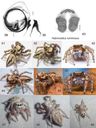
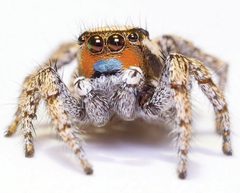

Pronunciation
How to pronounce Habronattus luminosus: /ˌhæbroʊˈnætəs lʊˈmɪnoʊsəs/
These audio files are automatically generated. While they are not always 100% accurate, they are a good starting point.
Images
Habitat
Ground-dwelling in areas of scattered vegetation, including prairie and grassland with stones and leaf litter. in this are frequently found on the ground rather than in arboreal settings.
Distribution
United States; North America. The Habronattus shows highest diversity in the southwestern U.S., with ranging above the Arctic Circle and east to coastal Canada.
Behavior
Males of related Habronattus perform complex combining visual signals with substrate-borne acoustic vibrations. These displays have been described as among the most elaborate of any terrestrial , involving leg movements, drumming, and tapping synchronized in an orchestral-like composition.
Similar Taxa
- Euophrys monadnockBoth are small, colorful jumping spiders found in similar in Colorado. Males of both display bright coloration and were initially mistaken for Habronattus species by observers due to shared ground-dwelling habits and male coloration.
- Habronattus cuspidatusCongeneric sharing the same characteristics including small size, ground-dwelling , and modified third legs in males for visual .
More Details
Taxonomic recency
Described in 2017, this is a relatively recently recognized within a that has undergone significant taxonomic revision. The genus Habronattus itself has been subject to ongoing study regarding species boundaries and relationships.