
Habronattus hirsutus
(G. W. Peckham & E. G. Peckham, 1888)
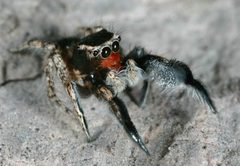
Habronattus hirsutus is a of jumping spider ( Salticidae) found in North America. It belongs to a large of small spiders renowned for elaborate involving both visual and vibratory signals. Males of the genus Habronattus typically possess modified third legs used in mating rituals. The species name 'hirsutus' refers to hairy characteristics, though specific morphological details for this species are not well documented in available sources.
Pronunciation
How to pronounce Habronattus hirsutus: //hæˌbroʊˈnætəs hɜrˈsuːtəs//
These audio files are automatically generated. While they are not always 100% accurate, they are a good starting point.
Identification
Identification to level within Habronattus requires examination of external genitalia under magnification. The Habronattus can be distinguished from other jumping spider genera by the presence of modified third legs in males, often with spurs or dense hair brushes on the 'knee' joint, used in . Species-level identification of H. hirsutus specifically cannot be confirmed from color pattern alone.
Images
Habitat
Members of the Habronattus are typically found on the ground in areas of scattered vegetation, prowling on stones or amid leaf litter. The genus shows highest diversity in the southwestern United States.
Distribution
North America. The Habronattus occurs across North America from above the Arctic Circle to coastal Canada, throughout the United States with highest diversity in the Southwest, and extends into the neotropics.
Behavior
Males of the Habronattus perform complex multimodal courtship involving visual displays with modified third legs and synchronized vibratory signals transmitted through the substrate. These have been described as among the most elaborate of any terrestrial .
Similar Taxa
- Other Habronattus speciesMany in this share similar size, preference, and male leg modifications. Microscopic examination of genitalia is required for definitive separation.
- Euophrys monadnockAnother small, colorful jumping spider found in similar ground-dwelling in North America, particularly in Colorado and northern latitudes. Males of E. monadnock have distinctive black and orange leg coloration that could cause confusion with Habronattus males.
More Details
Taxonomic Note
The Habronattus contains approximately 100 , most occurring in North America. The specific epithet 'hirsutus' (meaning hairy) distinguishes this species from , though detailed species descriptions are sparse in readily available literature.
Sources and further reading
- BugGuide
- Wikipedia
- GBIF taxonomy match
- NCBI Taxonomy
- Catalogue of Life
- Grasshopper Collections and Survey
- Bug Eric: What a Spider!
- Bug Eric: September 2012
- Bug Eric: Odd Little Weevils
- Bug Eric: A Case of Predator Mimicry in the Bee Fly Genus Epacmus? (Diptera: Bombyliidae)
- Study ranks potentially harmful invasive species in Ghana