
Habronattus borealis
(Banks, 1895)
Boreal Paradise Spider
Habronattus borealis is a of jumping spider in the Salticidae, native to North America. It was first described by Nathan Banks in 1895, with earlier observations by J. H. Emerton in 1901 from salt marsh in Massachusetts. The species is part of the diverse Habronattus , known for sexually dimorphic males with elaborate . It inhabits ground-level environments and has been documented across Canada and the United States.

Pronunciation
How to pronounce Habronattus borealis: /hæbroʊˈnætəs bɔːˈriælɪs/
These audio files are automatically generated. While they are not always 100% accurate, they are a good starting point.
Identification
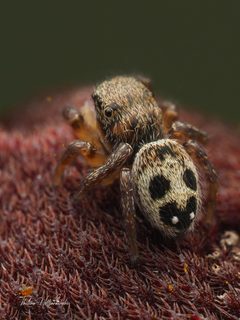
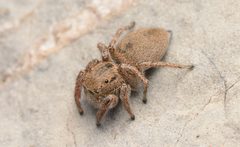
Males are brown and black; females are brown. Subadult males have a red . As with other Habronattus , males likely possess enlarged and modified front legs used in visual , though specific diagnostic features for H. borealis require direct comparison with .
Images
Habitat
Ground-dwelling in salt marshes and other open . Historical collections indicate preference for low vegetation and bare ground substrates typical of marsh environments.
Distribution
Canada and the United States. Specific records include Manitoba and Ontario in Canada.
Similar Taxa
- Habronattus coecatusInitially confused with H. borealis by Emerton and Peckham upon discovery; distinguished by subtle morphological differences in coloration and pattern.
Sources and further reading
- BugGuide
- Wikipedia
- GBIF taxonomy match
- iNaturalist taxon
- NCBI Taxonomy
- Catalogue of Life
- Bugs for All, All for Bugs | Bug Squad
- Grasshoppers of Wyoming and the West
- Zombie bees, Apis mellifera, and their tormentor the humpbacked fly, Apocephalus borealis — Bug of the Week
- Did One Praying Mantis Give Rise to an All-Female Species?
- Back-Seat Driver: The Parasite That Makes Bees Drop Off Its Babies
- Bug Eric: What a Spider!